
 Laos travel advice

Latest updates: Thorough review and update of the entire content
Last updated: ET
On this page
- Risk level
- Safety and security
- Entry and exit requirements
- Health
- Laws and culture
- Natural disasters and climate
- Need help?
 Risk level
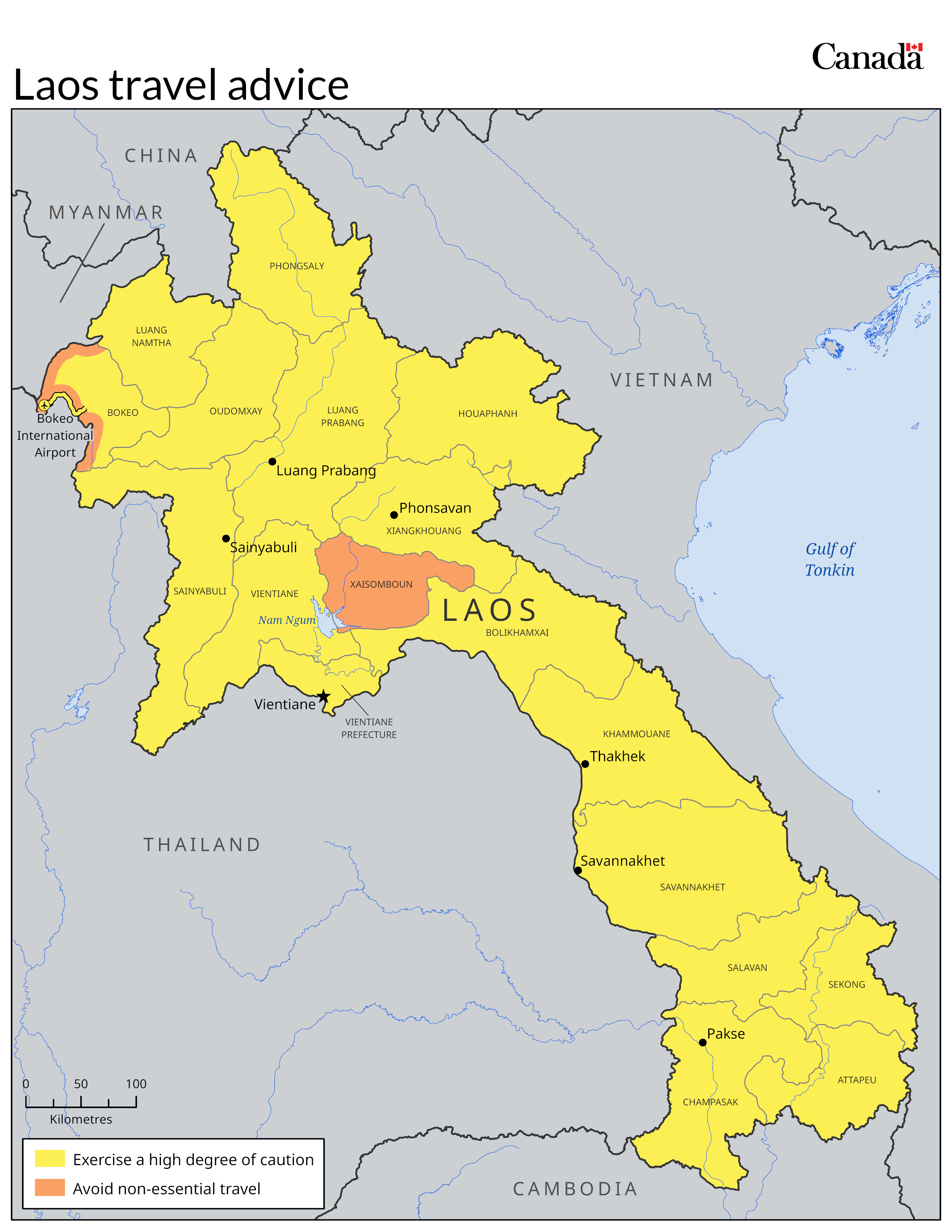
Disclaimer
The features in this map do not constitute an authoritative source of geographical information. This map is solely intended to assist Canadians by illustrating the risk levels contained in the Travel Advice and Advisories for this destination. The features in this map do not necessarily represent the views of the Canadian government on international boundaries, nomenclature or political status. The text under the Risk levels section takes precedence over this map.
Laos travel advice
Disclaimer
The features in this map do not constitute an authoritative source of geographical information. This map is solely intended to assist Canadians by illustrating the risk levels contained in the Travel Advice and Advisories for this destination. The features in this map do not necessarily represent the views of the Canadian government on international boundaries, nomenclature or political status. The text under the Risk levels section takes precedence over this map.
Laos - Exercise a high degree of caution
Exercise a high degree of caution in Laos due to ongoing security concerns related to banditry, crime, spiked food and drinks, and unexploded munitions.
Xaisomboun province - Avoid non-essential travel
Avoid non-essential travel to Xaisomboun province due to the tense security situation and random shooting incidents.
Areas of Bokeo province - Avoid non-essential travel
Avoid non-essential travel to the following areas of Bokeo province due to criminal activity:
- within 10 km of the borders with Myanmar and Thailand, excluding Bokeo International Airport and Road 3 leading there
- the Golden Triangle Special Economic Zone
 Safety and security
Xaisomboun province
There have been random shooting incidents near Xaisomboun town, in Xaisomboun province, since late 2015.
If you travel to this region despite the advisory:
- avoid travel after dark
- exercise extreme caution
- follow the instructions of local authorities
Bokeo province
Criminals operate in the Golden Triangle Special Economic Zone, which is in the Ton Pheung district of Bokeo province, and along the borders with Thailand and Myanmar. The criminal activity includes drug and human trafficking as well as employment scams.
If you travel to these areas despite the advisory:
- avoid travel after dark
- exercise extreme caution
- follow the instructions of local authorities
Officials have heightened security measures in Bokeo province, including an increased military presence at checkpoints along the Lao-Thai border, following clashes between the Lao army and unidentified armed groups.
Crime
Petty crime
Street crime is prevalent in cities and towns, including Vientiane, Luang Prabang and Vang Vieng.
Theft occurs frequently. Thieves on motorcycles grab bags and other valuables from pedestrians as well as from other motorcycle drivers and their passengers. Thieves also work in pairs to carry out distraction thefts.
During your trip:
- keep your personal belongings, including your passport and other travel documents, in a secure place
- when walking, keep your bag on the side of your body that is facing away from the road
- do not show signs of affluence or wear expensive jewellery
- be aware of your surroundings, especially in busy tourist areas
Violent crime
Violent muggings involving weapons have occurred, particularly in Vientiane, Luang Prabang, Pakse and Vang Vieng.
Break-ins at hotels and guesthouses occur. Armed robberies occur occasionally.
Local police may not have the capacity to respond to crimes, especially at night.
During your trip:
- always keep doors and windows closed and locked
- avoid going out after dark
- travel in groups
- do not resist an attack
Fraud
Report any fraud or scams to the local tourist police in the jurisdiction where the incident occurred before you leave the country.
Currency exchange scams
Be wary of money counting scams (currency exchange). Don't exchange large sums of money in one transaction. Get local currency from the bank or an ATM instead of a currency exchange kiosk.
Vehicle rental scams
Rent only from reputable companies, since some companies have been known to steal vehicles, particularly motorcycles, and charge for the loss. Never leave your passport as collateral when renting a vehicle, since they may be withheld until the charges are paid.
Credit card, debit card and ATM fraud
Credit and debit card as well as ATM fraud occurs frequently.
When using your debit or credit card:
- cover the keypad with one hand when entering your PIN
- pay careful attention when others are handling your cards
- avoid using card readers with an irregular or unusual feature
- use ATMs located in public areas or inside a bank or business
- check for any unauthorized transactions on your account statements
Spiked food, drinks and other items
Never leave your food or drinks unattended or in the care of strangers. Avoid accepting snacks, beverages, gum or cigarettes from new acquaintances, as these items may contain drugs that could put you at risk of sexual assault and robbery.
Some food and drinks, such as "happy pizzas" and "special shakes," may contain unspecified amounts of opium and other unknown substances. These items are sold in areas frequented by tourists, particularly in Vang Vieng. While these items may be easily accessible, taking any amount of opiates can be dangerous. Foreigners, including Canadians, have died of drug overdoses.
Methanol poisoning
Several foreigners in Vang Vieng have died or become severely ill as a result of alcohol poisoning from suspected methanol-adulterated alcohol. Methanol is extremely toxic and you can’t taste or smell it.
- Be vigilant if you choose to drink alcohol
- Avoid accepting free or extremely low-priced drinks
- Buy drinks only from licensed bars and restaurants
- In shops, buy alcohol only in sealed bottles and cans
- Follow orders issued by local authorities
- Do not purchase or consume Tiger brand vodka and whisky, which are prohibited
- Seek medical assistance immediately if you begin to feel sick
Women's safety
Sexual assaults occur, particularly in Vientiane, Luang Prabang and Vang Vieng. Be particularly vigilant along hiking trails.
If you’re the victim of a sexual assault, you should report it immediately to the nearest Government of Canada office.
Demonstrations
Demonstrations are illegal in Laos but sometimes occur.
Even peaceful demonstrations can turn violent. They can also lead to disruptions to traffic and public transportation.
- Avoid areas where demonstrations and large gatherings are taking place
- Follow the instructions of local authorities
- Monitor local media for information on ongoing demonstrations
Mass gatherings (large-scale events)
Adventure tourism
Outdoor activities, such as zip-lining and rock climbing, can be dangerous.
Tour operators may not meet Canadian safety standards.
Exercise extreme caution and carefully consider your safety when engaging in river-based activities, including in Vang Vieng. Travellers have died or been seriously injured while tubing or jumping/diving into the river. River levels can fluctuate considerably, and debris can make these activities dangerous. Avoid consuming alcohol or drugs before participating in river-based activities.
If you intend to participate in adventure tourism activities:
- share your itinerary with a friend or family member if you’re alone
- choose a reputable and well-established company that has insurance
- buy travel insurance that covers these types of recreational activities
- ensure that your physical condition is good enough to meet the challenges of your activity
- ensure that you have proper equipment and bring sufficient water
- refrain from using equipment if you are unsure of its condition or safety
- stay on marked trails and consider hiring an experienced guide from a reputable company
Adventure travel health and safety
Tourist facilities
Tourist facilities outside Vientiane and Luang Prabang are limited.
Security officials may place foreigners under surveillance. Hotel rooms, telephones, fax machines and electronic communications may be monitored. Personal possessions in hotel rooms may be searched.
Public transportation
Public transportation is unreliable and limited after dark. Vehicles may be in poor condition.
River travel is common in Laos. Safety standards are minimal. Speedboat travel is especially dangerous during the dry season (November to May). Lifejackets and helmets should be provided to and worn by passengers.
Do not travel on or across the Mekong River after dark. In some areas, the Laotian military has been known to shoot at boats after dark.
Landmines
Landmines and unexploded ordnance pose a risk to travellers throughout the country, but particularly in:
- the Plain of Jars site
- Xiengkhouang province
- Lao-Vietnam border areas, including those traversing the former Ho Chi Minh Trail
If you are travelling in the affected areas:
- be especially vigilant in remote areas
- stay on main roads
- avoid walking in fields/rural areas
- avoid roadside ditches, shoulders and unmarked trails
- only cross at official border crossings
- pay attention to signs indicating the possible presence of landmines
- report any suspicious items to local authorities
Roads
Road conditions
Road conditions are poor throughout the country.
Driving conditions may be hazardous during the rainy season.
Driving can also be dangerous due to:
- insufficient lighting
- unpaved roads
- poorly maintained vehicles
- stray livestock
Driving habits
Drivers don’t always respect traffic laws. They can be aggressive and reckless.
If you plan to travel by car, consider hiring a driver.
If you choose to drive:
- always drive defensively
- plan your trip in advance, especially if you are visiting a rural area
- familiarize yourself with your itinerary before you leave
- avoid travelling after dark
- only use main roads and highways
Air travel
We don't make assessments on the compliance of foreign domestic airlines with international safety standards.
 Entry and exit requirements
The authorities of a country or territory decide who can enter or exit through its borders. The Government of Canada cannot intervene on your behalf if you do not meet your destination’s entry or exit requirements.
We have obtained the information on this page from the Lao authorities. It can, however, change at any time.
Verify this information with the Foreign Representatives in Canada.
Passport
Entry requirements vary depending on the type of passport you're travelling with.
Before you travel, check with your transportation company about passport requirements. Its rules on passport validity may be more stringent than the country's entry rules.
Regular Canadian passport
Your passport must be valid for at least 6 months beyond the date you expect to leave Laos.
Passport for official travel
Different entry rules may apply.
Passport with “X” gender identifier
While the Government of Canada issues passports with an “X” gender identifier, it cannot guarantee your entry or transit through other countries. You might face entry restrictions in countries that do not recognize the “X” gender identifier. Before you leave, verify this information with the closest foreign representative for your destination.
You should also be aware that current systems used by some countries and travel companies may not recognize the “X” gender identifier. You may still be asked to provide your sex/gender information as either male or female when travelling.
Other travel documents
Different entry rules may apply when travelling with a temporary passport or an emergency travel document. Before you leave, verify this information with the closest foreign representative for your destination.
Useful links
- Travel and your sexual orientation, gender identity, gender expression and sex characteristics
- Foreign Representatives in Canada
- Canadian passports and other travel documents
Visas
Tourist visa: required
Business visa: required
Student visa: required
If you plan to enter Laos through Wattay International Airport or the First Lao-Thai Friendship Bridge, you can obtain an electronic tourist visa in advance for a fee.
You can obtain a tourist visa upon arrival at Wattay International Airport, Luang Prabang International Airport, Pakse International Airport and some “international” (that is, open to all foreign nationals) border crossings. Contact the nearest Lao embassy or consulate to confirm where you can get a tourist visa. You must provide a passport photo and pay a fee to obtain a visa upon arrival.
Electronic tourist visa – Lao Ministry of Foreign Affairs
Entry stamp
Immigration offices at some border crossings are difficult to identify. Ensure that you obtain an entry stamp when you enter Laos. Failure to do so can result in serious fines, detention and deportation.
Travel to Xaisomboun province
You must obtain permission from local authorities before travelling to certain parts of Xaisomboun province. You may be refused entry to some areas of the province, particularly around Long Tieng.
Children and travel
Learn about travelling with children.
Yellow fever
Learn about potential entry requirements related to yellow fever (vaccines section).
 Health
Relevant Travel Health Notices
- Measles: Advice for travellers - 13 November, 2025
- COVID-19 and International Travel - 12 May, 2025
This section has information and advice about health risks you might face when travelling. Following this advice can help reduce your risk of getting sick. Not all risks are listed here.
It's best to talk to a healthcare provider or visit a travel health clinic preferably 6 weeks before your trip to get personalized health advice. Even if your travel date is coming up soon, it's still worthwhile to make an appointment.
Routine vaccines
Make sure your routine vaccinations are up-to-date before you travel, no matter where you’re going.
These may include vaccines for measles, mumps, and rubella (MMR), diphtheria, tetanus, pertussis (whooping cough), polio, varicella (chickenpox), meningococcal disease, seasonal flu, and others.
Provincial and Territorial Immunization Information
Pre-travel vaccines and medications
When travelling in this destination, you might be at risk for diseases that can be prevented with vaccines or medications. Talk to a travel health care provider about which ones are right for you based on your travel plans.
The highlights below will also tell you if your destination may require that vaccine for entering or exiting.
Yellow Fever - Country Entry Requirements
Yellow fever is a disease caused by a flavivirus from the bite of an infected mosquito.
Travellers get vaccinated either because it is required to enter a country or because it is recommended for their protection.
Risk
- There is no risk of yellow fever in this country.
Country Entry Requirement*
- Proof of vaccination is not required to enter this country.
Recommendation
- Vaccination is not recommended.
* It is important to note that country entry requirements may not reflect your risk of yellow fever at your destination. It is recommended that you contact the nearest diplomatic or consular office of the destination(s) you will be visiting to verify any additional entry requirements.
Hepatitis A
There is a risk of hepatitis A in this destination. It is a disease of the liver. People can get hepatitis A if they ingest contaminated food or water, eat foods prepared by an infectious person, or if they have close physical contact (such as oral-anal sex) with an infectious person, although casual contact among people does not spread the virus.
Practise safe food and water precautions and wash your hands often. Vaccination is recommended for all travellers to areas where hepatitis A is present.
Influenza
The best way to protect yourself from seasonal influenza (flu) is to get vaccinated every year. Get the flu shot at least 2 weeks before travelling.
The flu occurs worldwide.
- In the Northern Hemisphere, the flu season usually runs from November to April.
- In the Southern Hemisphere, the flu season usually runs between April and October.
- In the tropics, there is flu activity year round.
The flu vaccine available in one hemisphere may only offer partial protection against the flu in the other hemisphere.
The flu virus spreads from person to person when they cough or sneeze or by touching objects and surfaces that have been contaminated with the virus. Clean your hands often and wear a mask if you have a fever or respiratory symptoms.
Malaria
Malaria is a serious and sometimes fatal disease that is caused by parasites spread through the bites of mosquitoes.
There is a risk of malaria in certain areas and/or during a certain time of year in this destination.
Antimalarial medication may be recommended depending on your itinerary and the time of year you are travelling. Consult a health care professional or visit a travel health clinic before travelling to discuss your options. It is recommended to do this 6 weeks before travel, however, it is still a good idea any time before leaving.
Protect yourself from mosquito bites at all times:
• Cover your skin and use an approved insect repellent on uncovered skin.
• Exclude mosquitoes from your living area with screening and/or closed, well-sealed doors and windows.
• Use insecticide-treated bed nets if mosquitoes cannot be excluded from your living area.
• Wear permethrin-treated clothing.
If you develop symptoms similar to malaria when you are travelling or up to a year after you return home, see a health care professional immediately. Tell them where you have been travelling or living.
Rabies
In this destination, rabies is commonly carried by dogs and some wildlife, including bats. Rabies is a deadly disease that spreads to humans primarily through bites or scratches from an infected animal. While travelling, take precautions, including keeping your distance from animals (including free-roaming dogs), and closely supervising children.
If you are bitten or scratched by a dog or other animal while travelling, immediately wash the wound with soap and clean water and see a health care professional. In this destination, rabies treatment may be limited or may not be available, therefore you may need to return to Canada for treatment.
Before travel, discuss rabies vaccination with a health care professional. It may be recommended for travellers who are at high risk of exposure (e.g., occupational risk such as veterinarians and wildlife workers, children, adventure travellers and spelunkers, and others in close contact with animals).
Measles
Measles is a serious viral infection that spreads easily. It spreads through the air, and can stay in the air for up to 2 hours. You can also get measles by direct contact with an infected person or by touching a surface with the virus on it and then touching your eyes, nose, or mouth before washing your hands.
Getting vaccinated is the best way to protect yourself and others from measles. In Canada, the measles vaccine is part of the routine immunization schedule. If you’re unsure whether you’re protected, talk to a healthcare provider.
Learn more:
Japanese encephalitis
Japanese encephalitis is a viral infection that can cause swelling of the brain. It is spread to humans through the bite of an infected mosquito. Risk is very low for most travellers. Travellers at relatively higher risk may want to consider vaccination for JE prior to travelling.
Travellers are at higher risk if they will be:
- travelling long term (e.g. more than 30 days)
- making multiple trips to endemic areas
- staying for extended periods in rural areas
- visiting an area suffering a JE outbreak
- engaging in activities involving high contact with mosquitos (e.g., entomologists)
Hepatitis B
Hepatitis B is a risk in every destination. It is a viral liver disease that is easily transmitted from one person to another through exposure to blood and body fluids containing the hepatitis B virus. Travellers who may be exposed to blood or other bodily fluids (e.g., through sexual contact, medical treatment, sharing needles, tattooing, acupuncture or occupational exposure) are at higher risk of getting hepatitis B.
Hepatitis B vaccination is recommended for all travellers. Prevent hepatitis B infection by practicing safe sex, only using new and sterile drug equipment, and only getting tattoos and piercings in settings that follow public health regulations and standards.
COVID-19
COVID-19 is an infectious viral disease. Most of the time, it spreads when people are in close contact with others who are infected with the virus. It spreads through respiratory particles, or through an infected surface or object.
Vaccination is one of the most important ways to protect yourself from developing serious complications from COVID-19. Talk to a healthcare provider about the COVID-19 vaccine before travelling. Evidence shows that the COVID-19 vaccines used in Canada are very effective at preventing severe illness, hospitalization and death from COVID-19.
In addition to vaccination, use personal protective measures to help protect yourself and others.
Learn more :
Vaccine for COVID-19: How to get vaccinated
COVID-19: Spread, prevention and risks
Safe food and water precautions
Eating or drinking unsafe food or water, or swimming in contaminated water can make you sick while travelling. Take precautions by following these tips:
- Boil it, cook it, peel it, or leave it (only eat food that is prepared safely)
- Avoid, if possible, getting water in your eyes, mouth, or nose when swimming in freshwater (like streams, lakes, or canals), especially after heavy rain or flooding - the water might look clean but can still be contaminated
- Don’t swallow water when bathing, showering, swimming in pools, or using hot tubs
Travellers' diarrhea
Travellers' diarrhea is the most common illness affecting travellers. It is spread from eating or drinking contaminated food or water.
Risk of developing travellers' diarrhea increases when travelling in regions with poor standards of hygiene and sanitation. Practise safe food and water precautions.
The most important treatment for travellers' diarrhea is rehydration (drinking lots of fluids). Carry oral rehydration salts when travelling.
Typhoid
Typhoid is a bacterial infection spread by contaminated food or water. Risk is higher among children, travellers going to rural areas, travellers visiting friends and relatives or those travelling for a long period of time.
Travellers visiting regions with a risk of typhoid, especially those exposed to places with poor sanitation, should speak to a health care professional about vaccination.
Schistosomiasis
There is a risk of schistosomiasis in this destination. Schistosomiasis is a parasitic disease caused by tiny worms (blood flukes) which can be found in freshwater (lakes, rivers, ponds, and wetlands). The worms can break the skin, and their eggs can cause stomach pain, diarrhea, flu-like symptoms, or urinary problems. Schistosomiasis mostly affects underdeveloped and rural communities, particularly agricultural and fishing communities.
Most travellers are at low risk. Travellers should avoid contact with untreated freshwater such as lakes, rivers, and ponds (e.g., swimming, bathing, wading, ingesting). There is no vaccine or medication available to prevent infection.
Tick and insect bite prevention
Many diseases are spread by bites from infected ticks and insects like mosquitoes, fleas, or flies. Before you travel, find out what types of ticks or insects are in the area, when they’re most active, and what diseases they can spread.
To protect yourself from bites:
- use an approved bug spray (insect repellent) on exposed skin
- wear light-coloured, loose clothing made of tightly woven materials like nylon or polyester
- wear socks and closed-toe shoes
- sleep under mosquito netting if you’re outdoors or staying in places that aren’t fully enclosed
- do a full body tick check on yourself, your children, your gear, and any pets you’re travelling with when you return from outdoor activities
Insect bite and pest prevention
Personal insect repellents
Chikungunya
There is a risk of chikungunya in this country. The level of risk may vary by:
- season
- year
- region
- elevation
The virus that causes chikungunya is spread through the bite of an infected mosquito. It can cause fever and pain in the joints. In some cases, the joint pain can be severe and last for months or years.
Protect yourself from mosquito bites at all times.
Insect bite and pest prevention
A vaccine for the prevention of chikungunya is approved in Canada. Talk to your healthcare provider about how best to prevent chikungunya, including the benefits and risks of vaccination based on factors such as your age, itinerary and personal preferences.
Learn more:
Zika virus
Zika virus is a risk in this country.
Zika virus is primarily spread through the bite of an infected mosquito. It can also be sexually transmitted. Zika virus can cause serious birth defects.
During your trip:
- Prevent mosquito bites at all times.
- Use condoms correctly or avoid sexual contact, particularly if you are pregnant.
If you are pregnant or planning a pregnancy, you should discuss the potential risks of travelling to this destination with your health care provider. You may choose to avoid or postpone travel.
For more information, see Zika virus: Pregnant or planning a pregnancy.
Dengue
- In this country, dengue is a risk to travellers. It is a viral disease spread to humans by mosquito bites.
- Dengue can cause flu-like symptoms. In some cases, it can lead to severe dengue, which can be fatal.
- The level of risk of dengue changes seasonally, and varies from year to year. The level of risk also varies between regions in a country and can depend on the elevation in the region.
- Mosquitoes carrying dengue typically bite during the daytime, particularly around sunrise and sunset.
- Protect yourself from mosquito bites. There is no vaccine or medication available in Canada to prevent dengue.
Learn more:
Dengue
Insect bite and pest prevention
Animal precautions
Some infections can spread directly from animals to people, like rabies or bird flu (avian influenza). Others don’t spread directly from animals but can infect people who visit areas animals have contaminated with their droppings or body fluids.
Certain activities can increase your chances of coming into contact with animals, their droppings, or their body fluids, like:
- travelling in rural or forested areas
- camping, hiking, or visiting caves
- visiting places where live animals are sold or killed for food, like wet markets
To reduce your risk of getting sick:
- avoid contact with animals like stray dogs, livestock (such as pigs and cows), monkeys, snakes, rodents, birds, and bats.
- stay away from places where animal waste can build up, such as caves
- avoid eating undercooked meat
Make sure to closely watch children; they are more likely to try to touch animals.
Avian Influenza
Human cases of avian influenza have been reported in this destination. Avian influenza is a viral infection that can spread quickly and easily among birds and in rare cases it can infect mammals, including people. The risk is low for most travellers.
Avoid contact with birds, including wild, farm, and backyard birds (alive or dead) and surfaces that may have bird droppings on them. Ensure all poultry dishes, including eggs and wild game, are properly cooked.
Travellers with a higher risk of exposure include those:
- visiting live bird/animal markets or poultry farms
- working with poultry (such as chickens, turkeys, domestic ducks)
- hunting, de-feathering, field dressing and butchering wild birds and wild mammals
- working with wild birds for activities such as research, conservation, or rehabilitation
- working with wild mammals, especially those that eat wild birds (e.g., foxes)
All eligible people are encouraged to get the seasonal influenza shot, which will protect them against human influenza viruses. While the seasonal influenza shot does not prevent infection with avian influenza, it can reduce the chance of getting sick with human and avian influenza viruses at the same time.
Person-to-person infections
When travelling, you can reduce your risk of getting or spreading respiratory infections, like the flu or COVID-19, by:
- staying at your accommodation and limiting contact with others if you’re sick
- wearing a well-fitting mask, especially:
- if you’re sick and need to be around others
- when you’re at large indoor events or in crowded settings, like sporting events, concerts, and airports
- cleaning your hands regularly with soap and water for at least 20 seconds, or using hand sanitizer containing at least 60% alcohol
- covering your coughs and sneezes with a tissue or your elbow, not your hands
Mass gatherings (large-scale events)
Clean your hands to help reduce the spread of infectious diseases
Respiratory infectious diseases: How to reduce the spread with personal protective measures
To lower your risk of getting sexually transmissible infections (STIs), HIV, and mpox, you can:
- get vaccinated against mpox if you’re eligible
- practise safer sex methods
- use barrier protection during sexual activity, like condoms and dental dams.
Mpox vaccines
Sexual health and travel
HIV and AIDS: Travel health advice
Tuberculosis
Tuberculosis is an infection caused by bacteria and usually affects the lungs.
For most travellers the risk of tuberculosis is low.
Travellers who may be at high risk while travelling in regions with risk of tuberculosis should discuss pre- and post-travel options with a health care professional.
High-risk travellers include those visiting or working in prisons, refugee camps, homeless shelters, or hospitals, or travellers visiting friends and relatives.
Medical services and facilities
Medical facilities throughout Laos are scarce and operate below the standards you might expect in Canada.
Medical care for basic illnesses and injuries is available in Vientiane and Luang Prabang. To obtain suitable treatment for more complex cases, medical evacuation to Thailand is required.
Medical evacuation can be very expensive and difficult to organize, but you may need it in case of serious illness or injury.
Make sure you get travel insurance that includes coverage for medical evacuation and hospital stays.
Health and safety outside Canada
Keep in Mind...
The decision to travel is the sole responsibility of the traveller. The traveller is also responsible for his or her own personal safety.
Be prepared. Do not expect medical services to be the same as in Canada. Pack a travel health kit, especially if you will be travelling away from major city centres.
 Laws and culture
You must abide by local laws.
Learn about what you should do and how we can help if you are arrested or detained abroad.
Identification
Travellers are subject to search, detention and the possibility of fines by authorities if they can’t show suitable identification, such as a passport, and for not having an entry stamp in their passport.
Always carry identification and comply with requests to stop at checkpoints and roadblocks.
Smoking
It is prohibited to import, export, sell, buy, possess or use shisha, heated tobacco products, e-cigarettes, vaporizers and their refills. Convicted offenders can expect heavy fines or jail sentences.
Drugs
Penalties for possession, use or trafficking of illegal drugs are severe and may include the death penalty.
- Pack your own luggage and monitor it closely at all times
- Never transport other people’s packages, bags or suitcases
Illegal or restricted activities
Relationships between foreign citizens and Laotian citizens
Non-marital sexual relationships between foreign citizens and Lao citizens are against the law, as are various forms of cohabitation. Convictions for such offences can lead to prison sentences and large fines. Improper registration of a relationship to a Lao citizen can lead to similar penalties. Permission for marriage or engagement to a Lao citizen must be submitted in a formal application to Lao authorities.
Photography
Photographing sensitive installations is prohibited. This includes:
- military sites
- government buildings
- bridges
- airfields
Photography of military personnel is also prohibited.
Violators may be arrested and their equipment may be seized.
Other illegal activities
Other illegal activities include:
- religious proselytizing or distributing religious material
- panhandling
- nudity in public or at religious sites
Violators may be arrested, fined, imprisoned or deported.
Driving
You must carry an International Driving Permit.
Rental vehicles
Travellers involved in traffic accidents have been required to pay compensation for property damage or injury, regardless of who the police determine to be at fault. Lao insurers will generally only meet a small proportion of the costs of an accident and refuse to cover compensation, which can be the largest expense related to an accident.
Do not leave your passport as collateral when renting vehicles, including motorcycles. Read rental contracts thoroughly to ensure that the vehicle is correctly insured to cover damages and theft.
Culture
Public displays of affection, such as kissing, whether between opposite or same-sex couples, are not considered proper or polite.
Dual citizenship
Dual citizenship is not legally recognized in Laos.
If local authorities consider you a citizen of Laos, they may refuse to grant you access to Canadian consular services. This will prevent us from providing you with those services.
International Child Abduction
The Hague Convention on the Civil Aspects of International Child Abduction is an international treaty. It can help parents with the return of children who have been removed to or retained in certain countries in violation of custody rights. It does not apply between Canada and Laos.
If your child was wrongfully taken to, or is being held in Laos by an abducting parent:
- act as quickly as you can
- consult a lawyer in Canada and in Laos to explore all the legal options for the return of your child
- report the situation to the nearest Canadian government office abroad or to Global Affairs Canada by calling the Emergency Watch and Response Centre
If your child was removed from a country other than Canada, consult a lawyer to determine if The Hague Convention applies.
Be aware that Canadian consular officials cannot interfere in private legal matters or in another country's judicial affairs.
Useful links
- International Child Abductions: A guide for affected parents
- Children and travel
- Canadian embassies and consulates by destination
- Request emergency assistance
Money
The currency of Laos is the kip (LAK).
The kip is not easily obtained or exchanged outside of Laos. U.S. dollars and Thai baht are commonly accepted.
ATMs are widely available. Major credit cards are accepted at some international hotels and tourist establishments. Cash advances can be obtained from some banks, although the bank commission rates are high.
 Natural disasters and climate
Climate change
Climate change is affecting Laos. Extreme and unusual weather events are becoming more frequent and may affect your travel plans. Monitor local media for the latest information.
Typhoons and monsoons
The rainy season (monsoon) extends from May to November. It can bring typhoons and lead to severe flooding, especially in provinces along the Mekong River in southern Laos.
Seasonal flooding can hamper overland travel and reduce the provision of essential services. Roads may become impassable due to mudslides and landslides. Bridges, buildings, and infrastructure may be damaged.
- Monitor local media for the latest information, including on road conditions
- Stay away from flooded areas
- Monitor weather reports
- Follow the instructions of local authorities, including evacuation orders
 Need help?
Local services
Emergency services
In case of emergency, dial:
- police: 1191
- ambulance: 1195
- firefighters: 1190
- tourist police in Vientiane: 021 251 128
Consular assistance
Vientiane - Embassy of Canada
Bangkok - Embassy of Canada
Thailand, Cambodia, Laos
Appointment Book your appointment onlineFor emergency consular assistance, call the Embassy of Canada in Laos and follow the instructions. At any time, you may also contact the Emergency Watch and Response Centre in Ottawa.

Disclaimer
The decision to travel is your choice and you are responsible for your personal safety abroad. We take the safety and security of Canadians abroad very seriously and provide credible and timely information in our Travel Advice to enable you to make well-informed decisions regarding your travel abroad.
The content on this page is provided for information only. While we make every effort to give you correct information, it is provided on an "as is" basis without warranty of any kind, expressed or implied. The Government of Canada does not assume responsibility and will not be liable for any damages in connection to the information provided.
If you need consular assistance while abroad, we will make every effort to help you. However, there may be constraints that will limit the ability of the Government of Canada to provide services.
Learn more about consular services.
Risk Levels
 Take normal security precautions
Take similar precautions to those you would take in Canada.
 Exercise a high degree of caution
There are certain safety and security concerns or the situation could change quickly. Be very cautious at all times, monitor local media and follow the instructions of local authorities.
IMPORTANT:The two levels below are official Government of Canada Travel Advisories and are issued when the safety and security of Canadians travelling or living in the country or region may be at risk.
 Avoid non-essential travel
Your safety and security could be at risk. You should think about your need to travel to this country, territory or region based on family or business requirements, knowledge of or familiarity with the region, and other factors. If you are already there, think about whether you really need to be there. If you do not need to be there, you should think about leaving.
 Avoid all travel
You should not travel to this country, territory or region. Your personal safety and security are at great risk. If you are already there, you should think about leaving if it is safe to do so.
- Date modified: