
 Cuba travel advice

Latest updates: Editorial change
Last updated: ET
On this page
- Risk level
- Safety and security
- Entry and exit requirements
- Health
- Laws and culture
- Natural disasters and climate
- Need help?
 Risk level
Disclaimer
The features in this map do not constitute an authoritative source of geographical information. This map is solely intended to assist Canadians by illustrating the risk levels contained in the Travel Advice and Advisories for this destination. The features in this map do not necessarily represent the views of the Canadian government on international boundaries, nomenclature or political status. The text under the Risk levels section takes precedence over this map.
Cuba travel advice
Disclaimer
The features in this map do not constitute an authoritative source of geographical information. This map is solely intended to assist Canadians by illustrating the risk levels contained in the Travel Advice and Advisories for this destination. The features in this map do not necessarily represent the views of the Canadian government on international boundaries, nomenclature or political status. The text under the Risk levels section takes precedence over this map.
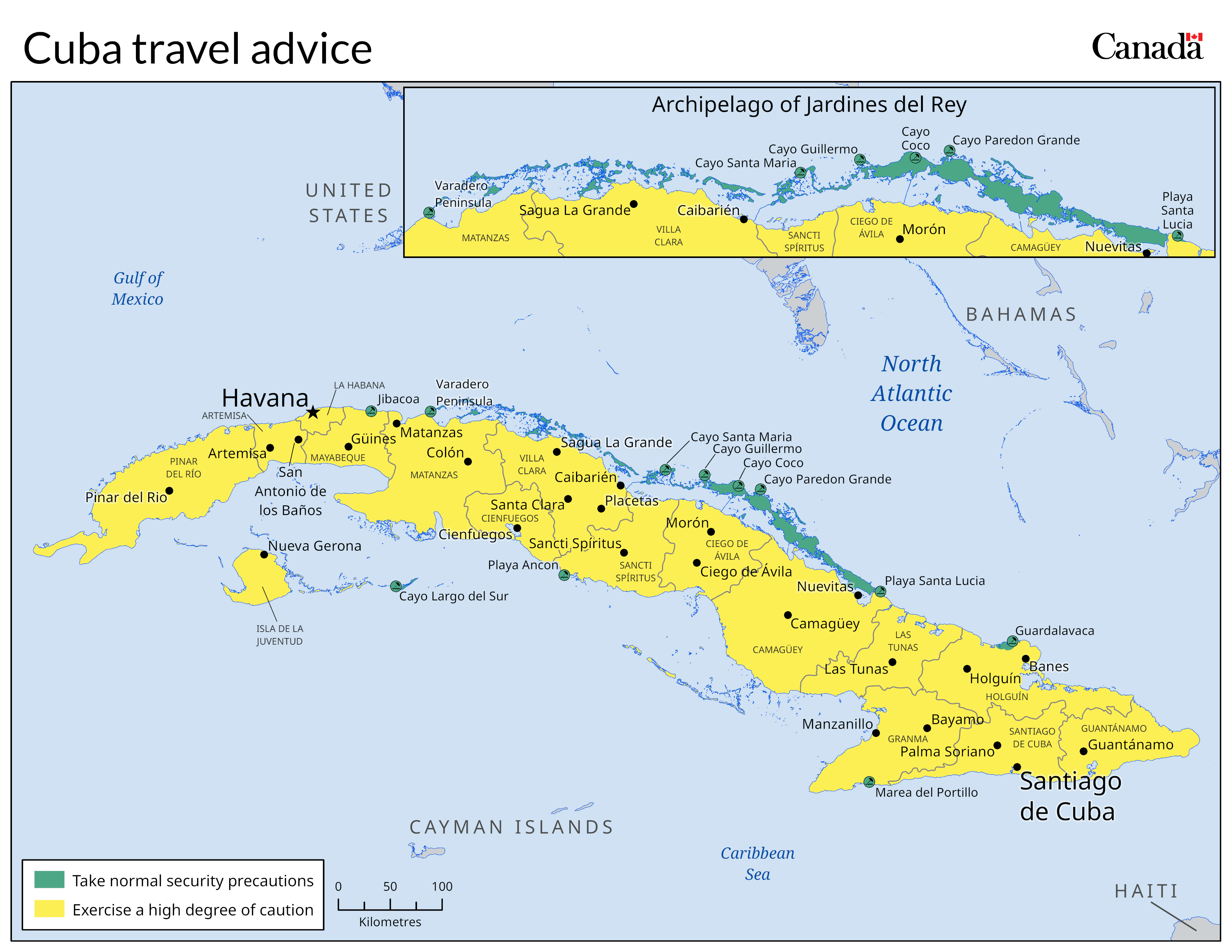
Cuba - Exercise a high degree of caution
Exercise a high degree of caution in Cuba due to shortages of basic necessities including food, medicine and fuel.
Archipelago of Jardines del Rey - Take normal security precautions
Take normal security precautions in the Archipelago of Jardines del Rey which includes:
- Cayo Coco
- Cayo Guillermo
- Cayo Paredon Grande
- Cayo Santa Maria
Resort areas - Take normal security precautions
Take normal security precautions in the Cuban resort areas of:
- Cayo Largo del Sur
- Guardalavaca coastline, between Playa Pesquero and Playa Bani
- Jibacoa
- Marea del Portillo
- Playa Ancon
- Playa Santa Lucia
- Varadero Peninsula
 Safety and security
Crime
Petty crime
Petty crime, such as pickpocketing and bag snatching, occurs.
Theft generally occurs in crowded places such as:
- tourist areas
- markets
- public buses
- night clubs
- beaches
It can also occur in isolated areas.
Cuba has a cash-based economy. You may need to carry large amounts of cash to make larger purchases, but doing so could make you a target for theft or robbery. You should avoid showing large amounts of cash in public.
Theft from hotel rooms, particularly in private accommodations (“casas particulares”), and from cars, is common.
- Always keep your personal belongings, including your passport and other travel documents, in a secure place
- Do not pack valuables in your checked luggage
- Avoid showing signs of affluence
- Keep electronic devices out of sight
- Keep a digital and a hard copy of your identification and travel documents
- Never leave belongings unattended in a vehicle, even in the trunk
Violent crime
Incidents of violent crime are not frequent, but assaults may occur. They mainly occur during a burglary or robbery.
- Stay in accommodations with good security
- Keep your windows and doors locked at all times
- If you’re threatened by robbers, stay calm and do not resist
Sexual assault
Incidents of sexual assault against Canadian women have occurred, including at beach resorts.
If you’re a victim of a sexual assault, you should report it immediately to the nearest Government of Canada office. You should file a report with the Cuban authorities and ensure that local police provide you with proof of complaint (“comprobante de denuncia”) confirming that a report has been filed. A criminal investigation will not be possible if no formal complaint is made to Cuban authorities before you depart the country.
Police officers may only speak Spanish.
- Avoid secluded areas, even on resorts and hotel grounds
- Exercise caution when dealing with strangers or recent acquaintances
- Avoid taking public transportation or walking alone at night
Fraud
Overcharging
Some businesses, including taxis and classic car rentals, may try to charge exorbitant prices.
- Always confirm the price before ordering or purchasing a good or service
- Do not leave an open tab
- Avoid giving your credit card to bar or restaurant staff
- Check the accuracy of your bill before paying
Scams
Some hustlers specialize in defrauding tourists, sometimes using threats or violence. Most of them speak some English or French and go out of their way to appear friendly. They may offer to serve as guides or facilitate the purchase of cigars.
Fraudulent tour agents and taxi drivers also operate throughout the country, including at Havana’s international airport. Thefts of luggage from taxi trunks have occurred.
In bars, sex workers, including minors, may be very persistent and intrusive with tourists who refuse their advances. Foreigners, including Canadians, have been victims of theft after engaging in sexual relations, and some of them have faced child sex accusations.
- Only use reputable tour operators and registered taxis
- Avoid independent street vendors
- Be wary of strangers who seem too friendly
Power outages
To reduce pressure on the electrical network, Cuba schedules long daily power cuts. Sometimes, unexpected nationwide power outages occur and can last more than 24 hours.
Most large hotels and resorts use generators during power outages. However, fuel shortages may impact generator use and the type of services provided.
- Monitor local media for the latest information
- Try to keep your phone charged
- Plan accordingly
Shortages
Cuba faces chronic and severe shortages of basic necessities, including:
- food
- bottled water
- public water supply
- medication
- fuel
- hard currency
Fuel shortages affect a wide range of services. Travelling across the island is extremely challenging. Public transportation services, including taxis, are often disrupted, leaving tourists with few options to travel. Some travellers have been temporarily stranded with a rental car. There are often long line-ups at gas stations that have led to altercations.
Intermittent shortages of tap water provided by municipalities occur, including in Havana. Water shortages have affected resorts in the past.
- Plan accordingly
- Bring some supplies with you, including toiletries and medication
- Keep a supply of water, food and fuel on hand
- Make sure you always have access to a complete emergency kit
Harassment
Individuals, including women, 2SLGBTQI+ persons and members of racialized groups, have been subject to harassment or verbal abuse.
Avoid travelling alone, especially at night. If you are the victim of harassment, you should report it immediately to the police and the nearest Government of Canada office.
Useful links
- Advice for women travellers
- Travel and your sexual orientation, gender identity, gender expression and sex characteristics
Spiked food, drinks and other items
Never leave your food or drinks unattended or in the care of strangers. Avoid accepting snacks, beverages, gum or cigarettes from new acquaintances, as these items may contain drugs that could put you at risk of sexual assault and robbery.
Telecommunications
The telecommunications network in Cuba is poor. Connections are unreliable and may be intermittent.
Canadian cell phones may not work, even in large cities. Internet access is limited across the island.
Local authorities control telecommunications. They may block access, including to social media, in case of civil unrest or before demonstrations.
- Do not rely on your cell phone for emergencies, especially outside major cities
- Subscribe to and install a VPN service before leaving Canada
Online transactions
Online banking may be challenging in Cuba. Most Cuban websites are unsecure. Many are inaccessible from outside of Cuba.
If you plan to book online, you should confirm that your hotel accepts online reservations and payments.
Demonstrations
Demonstrations occur occasionally. All demonstrations against the government are illegal. Local authorities may break up demonstrations or gatherings not sanctioned by the government.
Many demonstrators have been arrested. If you are close to a demonstration, you may be detained by the Cuban authorities.
Even peaceful demonstrations can turn violent at any time.
- Do not participate in demonstrations
- Avoid areas where demonstrations and large gatherings are taking place
- Follow the instructions of local authorities
- Monitor local media for information on ongoing demonstrations
Mass gatherings (large-scale events)
Water activities
Swimming
Tidal changes can cause powerful currents, and riptides are common. Lifeguard services don’t always meet Canadian standards. Not all beaches have lifeguards or warning flags to warn of unsafe conditions.
In marine areas, coral, jellyfish, stingrays and other marine life, especially the Portuguese man o’ war or “agua mala,” can poison, sting or cause infection if touched or stepped on.
Consult residents and tour operators for information on possible hazards, the presence of dangerous species and safe swimming areas. You should not swim in areas where harmful marine life is present.
- Never swim alone or after hours
- Do not swim outside marked areas
- Respect warning flags on the beach and do not swim when there is a red flag flying
- Avoid beaches and coastal areas if the weather forecast is poor
- Do not dive in unfamiliar waters, as hidden rocks or shallow depths can cause serious injury or death
- Follow the instructions of local authorities
Diving
Tour operators and diving centres may not meet Canadian safety standards. If you go diving:
- use a reputable company
- do not use the equipment if you are unsure of its safety
- make sure that your travel insurance covers incidents related to this type of recreational activity
Recreational boating
If you plan to go boating:
- know and respect the navigation rules
- have life jackets available for all passengers
- follow safe practices for all water activities such as jet skiing, water skiing or fishing
- do not overload your boat capacity
- carry a VHF marine radio that will generate your position in case of emergency
- be prepared for emergencies
Adventure travel health and safety
Roads
Road conditions
Road conditions are poor throughout the island, except the west-east Central Highway.
Driving may be dangerous due to:
- poorly maintained roads
- lack of traffic signs
- insufficient lighting
- livestock and horse-drawn carts
- pedestrians on the road
- slow-moving traffic
Many Cuban cars are old and in poor condition. They often lack standard safety equipment. Some cars and most bicycles don’t have functioning lights.
Driving habits
Some drivers don’t respect traffic laws. Many of them, driving electric bicycles for which licence and registration are not required, are inexperienced and unqualified. Drinking and driving is also common.
If you choose to drive in Cuba:
- always drive defensively
- avoid travelling after dark
- never pick up hitchhikers, who have been known to assault drivers
Public transportation
Buses
Public buses are unreliable, scarce, overcrowded and poorly maintained.
If you plan to travel by bus, use a private service offered by a tour company or resort.
Taxis
Old-model private vehicles offered as taxis are not equipped with standard safety features. They have no insurance coverage for passengers in case of an accident.
- Use only officially marked taxis
- Avoid hailing taxis on the street
- Never share a taxi with strangers
- Agree on a fare before departure, as taxis are not equipped with meters
Trains
The rail network is unreliable and slow.
Air travel
We don't make assessments on the compliance of foreign domestic airlines with international safety standards.
 Entry and exit requirements
The authorities of a country or territory decide who can enter or exit through its borders. The Government of Canada cannot intervene on your behalf if you do not meet your destination’s entry or exit requirements.
We have obtained the information on this page from the Cuban authorities. It can, however, change at any time.
Verify this information with the Foreign Representatives in Canada.
Passport
Entry requirements vary depending on the type of passport you're travelling with.
Before you travel, check with your transportation company about passport requirements. Its rules on passport validity may be more stringent than the country's entry rules.
Regular Canadian passport
Your passport must be valid for the expected duration of your stay in Cuba.
Passport for official travel
Different entry rules may apply.
Passport with “X” gender identifier
While the Government of Canada issues passports with an “X” gender identifier, it cannot guarantee your entry or transit through other countries. You might face entry restrictions in countries that do not recognize the “X” gender identifier. Before you leave, verify this information with the closest foreign representative for your destination.
You should also be aware that current systems used by some countries and travel companies may not recognize the “X” gender identifier. You may still be asked to provide your sex/gender information as either male or female when travelling.
Other travel documents
Different entry rules may apply when travelling with a temporary passport or an emergency travel document. Before you leave, verify this information with the closest foreign representative for your destination.
Useful links
- Travel and your sexual orientation, gender identity, gender expression and sex characteristics
- Foreign Representatives in Canada
- Canadian passports and other travel documents
Visas
Tourist visa: required
Family visa: required
Business visa: required
Canadian tourists travelling to Cuba need a visa, which allows for stays of up to 90 days.
The tourist visa is generally included in holiday packages provided by tour operators or airlines providing direct flights from Canada.
If you travel to Cuba via a third country, including on flights with stopovers in a third country, you must obtain a Cuban electronic visa ahead of time. A 10-character code will be provided, which you must include when filling out the online customs form.
Tourist visas – Government of Cuba
Length of stay
You may stay in Cuba for up to 6 months, but you must request an extension of stay if you intend to stay longer than the initial 90-day period allowed by the standard tourist visa.
D’Viajeros traveller information portal – Government of Cuba
Online customs form
You must provide information on your stay in Cuba via an online customs form before entering the country. You may complete it as early as 72 hours before entry.
Once done, you will receive a QR code by email.
You must show an electronic or printed version of the QR code upon check-in and to authorities upon arrival.
D’Viajeros traveller information portal – Government of Cuba
Cash controls
You cannot leave Cuba with more than $5,000 USD or the equivalent in any currency. You also cannot leave Cuba with more than $5,000 CUP.
Health insurance
You must be able to show proof of medical insurance upon entry to Cuba. If you don’t have proof of health insurance or if the proof you present doesn’t satisfy the Cuban immigration authorities, you may have to obtain health insurance from a Cuban insurance company upon arrival. This insurance may have limited coverage.
Canadian provincial health care coverage provides very limited coverage outside Canada. It won’t pay for medical bills up front and does not include air evacuation.
Cuban authorities won’t let you leave the country with outstanding medical bills. You will need to remain in Cuba until all debts are paid. Medical bills are payable by credit card only.
- Make sure you purchase the best health insurance you can afford
- Ensure the insurance includes medical evacuation and hospital stays
Trip interruption and travel health insurance
Other entry requirements
Customs officials may ask you to show them:
- a return or onward ticket
- proof of accommodation
Dual citizenship
If you’re both a Canadian and Cuban citizen, you must:
- present your valid Cuban passport to the immigration authorities to enter Cuba
- have a valid Canadian passport to return to Canada
If you were born in Cuba, you should contact a Cuban government office in Canada before you leave to ensure compliance with Cuban regulations, regardless of your current citizenship. Failure to do so may result in your being refused entry into Cuba or being detained upon entry.
Canadian permanent residents
You will not be able to leave Cuba if you are a Canadian permanent resident and are without a valid permanent resident card. If your card is lost or stolen, you must contact the Embassy of Canada to Cuba, in Havana, to obtain a travel document that will allow you to leave the country.
This procedure can take up to 10 working days. Once the document is ready, you'll need to make an appointment with the immigration section of the Embassy of Canada to Cuba to collect it before returning to Canada.
Permanent resident travel document: How to apply
Health screening
You may be subjected to a medical screening or interrogation by public health authorities when you enter or exit Cuba, or when reporting for domestic flights.
You may be subject to a mandatory quarantine for medical observation for up to 7 days if local authorities believe that:
- you have symptoms of a serious illness, such as:
- COVID-19
- Dengue
- Ebola
- H1N1
- Zika
- you have come into contact with a suspected carrier of one of these viruses
- you’re arriving from a country with a known epidemic
Restricted goods
Personal effects and medicine
You should bring all personal goods, including toiletries and medication, that you may require for the duration of your travel. Many of these items may be difficult to find in Cuba.
Cuban customs officials will decide if the amount is suitable for your personal use. They may apply steep tariffs for personal baggage exceeding the allowable amount.
Art objects
Some art objects, including artifacts and paintings purchased in Cuba, must be accompanied by an export permit. It’s usually provided by state-owned galleries. If you plan on buying art from a gallery, always confirm that you will be able to leave the country with it.
Electronic devices
Electronic devices with GPS technology may be confiscated upon entry and returned upon exit.
Satellite telephones are forbidden.
Electronic cigarettes and personal vaporizers
You cannot bring electronic cigarettes or personal vaporizers to Cuba.
Customs officials will seize these items upon arrival.
Children and travel
Yellow fever
Learn about potential entry requirements related to yellow fever (vaccines section).
 Health
Relevant Travel Health Notices
- Measles: Advice for travellers - 13 November, 2025
- COVID-19 and International Travel - 12 May, 2025
- Oropouche virus disease in the Americas - 22 December, 2025
- Dengue: Advice for travellers - 25 November, 2025
- Chikungunya: Advice for travellers - 12 January, 2026
This section has information and advice about health risks you might face when travelling. Following this advice can help reduce your risk of getting sick. Not all risks are listed here.
It's best to talk to a healthcare provider or visit a travel health clinic preferably 6 weeks before your trip to get personalized health advice. Even if your travel date is coming up soon, it's still worthwhile to make an appointment.
Outbreak Monitoring
Hepatitis A in Cuba
There have been reported cases of hepatitis A in return travellers from Cuba.
Hepatitis A is a liver disease caused by the hepatitis A virus. It is most commonly spread when someone eats food or drinks water that contains the virus.
The best way to prevent hepatitis A is to get vaccinated. Discuss the benefits of getting vaccinated with a health care provider before you travel.
In addition to vaccination, you can reduce your risk of getting hepatitis A by taking the following precautions:
- Wash your hands often, especially before preparing or eating food
- Take food and water precautions, such as:
- avoiding ice cubes in drinks
- peeling your own raw fruit and vegetables
- drinking water from a safe supply, such as bottled or boiled water
- eating only foods that are well-cooked unless you have prepared them yourself
- Practise safer sex methods
Learn more:
Causes of hepatitis A
Sexual health and travel
How to prevent hepatitis A
Eat and drink safely abroad
Hepatitis A - Who is most at risk
Clean your hands to help reduce the spread of infectious diseases
Routine vaccines
Make sure your routine vaccinations are up-to-date before you travel, no matter where you’re going.
These may include vaccines for measles, mumps, and rubella (MMR), diphtheria, tetanus, pertussis (whooping cough), polio, varicella (chickenpox), meningococcal disease, seasonal flu, and others.
Provincial and Territorial Immunization Information
Pre-travel vaccines and medications
When travelling in this destination, you might be at risk for diseases that can be prevented with vaccines or medications. Talk to a travel health care provider about which ones are right for you based on your travel plans.
The highlights below will also tell you if your destination may require that vaccine for entering or exiting.
Yellow Fever - Country Entry Requirements
Yellow fever is a disease caused by a flavivirus from the bite of an infected mosquito.
Travellers get vaccinated either because it is required to enter a country or because it is recommended for their protection.
Risk
- There is no risk of yellow fever in this country.
Country Entry Requirement*
- Proof of vaccination is required if you are coming from or have transited through an airport of a country where yellow fever occurs.
Recommendation
- Vaccination is not recommended.
- Discuss travel plans, activities, and destinations with a health care professional.
- Contact a designated Yellow Fever Vaccination Centre well in advance of your trip to arrange for vaccination.
Yellow Fever Vaccination Centres in Canada
* It is important to note that country entry requirements may not reflect your risk of yellow fever at your destination. It is recommended that you contact the nearest diplomatic or consular office of the destination(s) you will be visiting to verify any additional entry requirements.
Hepatitis A
There is a risk of hepatitis A in this destination. It is a disease of the liver. People can get hepatitis A if they ingest contaminated food or water, eat foods prepared by an infectious person, or if they have close physical contact (such as oral-anal sex) with an infectious person, although casual contact among people does not spread the virus.
Practise safe food and water precautions and wash your hands often. Vaccination is recommended for all travellers to areas where hepatitis A is present.
Measles
Measles is a serious viral infection that spreads easily. It spreads through the air, and can stay in the air for up to 2 hours. You can also get measles by direct contact with an infected person or by touching a surface with the virus on it and then touching your eyes, nose, or mouth before washing your hands.
Getting vaccinated is the best way to protect yourself and others from measles. In Canada, the measles vaccine is part of the routine immunization schedule. If you’re unsure whether you’re protected, talk to a healthcare provider.
Learn more:
Hepatitis B
Hepatitis B is a risk in every destination. It is a viral liver disease that is easily transmitted from one person to another through exposure to blood and body fluids containing the hepatitis B virus. Travellers who may be exposed to blood or other bodily fluids (e.g., through sexual contact, medical treatment, sharing needles, tattooing, acupuncture or occupational exposure) are at higher risk of getting hepatitis B.
Hepatitis B vaccination is recommended for all travellers. Prevent hepatitis B infection by practicing safe sex, only using new and sterile drug equipment, and only getting tattoos and piercings in settings that follow public health regulations and standards.
Influenza
The best way to protect yourself from seasonal influenza (flu) is to get vaccinated every year. Get the flu shot at least 2 weeks before travelling.
The flu occurs worldwide.
- In the Northern Hemisphere, the flu season usually runs from November to April.
- In the Southern Hemisphere, the flu season usually runs between April and October.
- In the tropics, there is flu activity year round.
The flu vaccine available in one hemisphere may only offer partial protection against the flu in the other hemisphere.
The flu virus spreads from person to person when they cough or sneeze or by touching objects and surfaces that have been contaminated with the virus. Clean your hands often and wear a mask if you have a fever or respiratory symptoms.
Rabies
In this destination, rabies is carried by dogs and some wildlife, including bats. Rabies is a deadly disease that spreads to humans primarily through bites or scratches from an infected animal. While travelling, take precautions, including keeping your distance from animals (including free-roaming dogs), and closely supervising children.
If you are bitten or scratched by an animal while travelling, immediately wash the wound with soap and clean water and see a health care professional. Rabies treatment is often available in this destination.
Before travel, discuss rabies vaccination with a health care professional. It may be recommended for travellers who are at high risk of exposure (e.g., occupational risk such as veterinarians and wildlife workers, children, adventure travellers and spelunkers, and others in close contact with animals).
COVID-19
COVID-19 is an infectious viral disease. Most of the time, it spreads when people are in close contact with others who are infected with the virus. It spreads through respiratory particles, or through an infected surface or object.
Vaccination is one of the most important ways to protect yourself from developing serious complications from COVID-19. Talk to a healthcare provider about the COVID-19 vaccine before travelling. Evidence shows that the COVID-19 vaccines used in Canada are very effective at preventing severe illness, hospitalization and death from COVID-19.
In addition to vaccination, use personal protective measures to help protect yourself and others.
Learn more :
Vaccine for COVID-19: How to get vaccinated
COVID-19: Spread, prevention and risks
Safe food and water precautions
Eating or drinking unsafe food or water, or swimming in contaminated water can make you sick while travelling. Take precautions by following these tips:
- Boil it, cook it, peel it, or leave it (only eat food that is prepared safely)
- Avoid, if possible, getting water in your eyes, mouth, or nose when swimming in freshwater (like streams, lakes, or canals), especially after heavy rain or flooding - the water might look clean but can still be contaminated
- Don’t swallow water when bathing, showering, swimming in pools, or using hot tubs
Travellers' diarrhea
Travellers' diarrhea is the most common illness affecting travellers. It is spread from eating or drinking contaminated food or water.
Risk of developing travellers' diarrhea increases when travelling in regions with poor standards of hygiene and sanitation. Practise safe food and water precautions.
The most important treatment for travellers' diarrhea is rehydration (drinking lots of fluids). Carry oral rehydration salts when travelling.
Typhoid
Typhoid is a bacterial infection spread by contaminated food or water. Risk is higher among children, travellers going to rural areas, travellers visiting friends and relatives or those travelling for a long period of time.
Travellers visiting regions with a risk of typhoid, especially those exposed to places with poor sanitation, should speak to a health care professional about vaccination.
Salmonellosis
Salmonellosis is a common illness among travellers to this country. It can be spread through contaminated food or beverages, such as raw or undercooked poultry and eggs, as well as fruits or vegetables.
Practice safe food and water precautions. This includes only eating food that is properly cooked and still hot when served.
Pregnant women, children under 5 years of age, those over 60 years of age, and those with weakened immune systems are at greater risk of becoming seriously ill.
Most people recover on their own without medical treatment and from proper rehydration (drinking lots of fluids).
-
- Carry oral rehydration salts when travelling.
Travellers with severe symptoms should consult a health care professional as soon as possible.
Tick and insect bite prevention
Many diseases are spread by bites from infected ticks and insects like mosquitoes, fleas, or flies. Before you travel, find out what types of ticks or insects are in the area, when they’re most active, and what diseases they can spread.
To protect yourself from bites:
- use an approved bug spray (insect repellent) on exposed skin
- wear light-coloured, loose clothing made of tightly woven materials like nylon or polyester
- wear socks and closed-toe shoes
- sleep under mosquito netting if you’re outdoors or staying in places that aren’t fully enclosed
- do a full body tick check on yourself, your children, your gear, and any pets you’re travelling with when you return from outdoor activities
Insect bite and pest prevention
Personal insect repellents
Chikungunya
There is a risk of chikungunya in this country. The level of risk may vary by:
- season
- year
- region
- elevation
The virus that causes chikungunya is spread through the bite of an infected mosquito. It can cause fever and pain in the joints. In some cases, the joint pain can be severe and last for months or years.
Protect yourself from mosquito bites at all times.
Insect bite and pest prevention
A vaccine for the prevention of chikungunya is approved in Canada. Talk to your healthcare provider about how best to prevent chikungunya, including the benefits and risks of vaccination based on factors such as your age, itinerary and personal preferences.
Learn more:
Dengue
- In this country, dengue is a risk to travellers. It is a viral disease spread to humans by mosquito bites.
- Dengue can cause flu-like symptoms. In some cases, it can lead to severe dengue, which can be fatal.
- The level of risk of dengue changes seasonally, and varies from year to year. The level of risk also varies between regions in a country and can depend on the elevation in the region.
- Mosquitoes carrying dengue typically bite during the daytime, particularly around sunrise and sunset.
- Protect yourself from mosquito bites. There is no vaccine or medication available in Canada to prevent dengue.
Learn more:
Dengue
Insect bite and pest prevention
Zika virus
Zika virus is a risk in this country.
Zika virus is primarily spread through the bite of an infected mosquito. It can also be sexually transmitted. Zika virus can cause serious birth defects.
During your trip:
- Prevent mosquito bites at all times.
- Use condoms correctly or avoid sexual contact, particularly if you are pregnant.
If you are pregnant or planning a pregnancy, you should discuss the potential risks of travelling to this destination with your health care provider. You may choose to avoid or postpone travel.
For more information, see Zika virus: Pregnant or planning a pregnancy.
Oropouche virus disease
Oropouche virus disease (OVD) is a risk in this destination. It is a disease caused by the Oropouche virus, which is spread to humans through the bite of an infected small fly called a midge (also known as no-see-um) and possibly certain mosquitos. Symptoms usually include fever, headache, joint and muscle pain, chills, and sometimes nausea and vomiting. In some cases, aseptic meningitis (inflammation of the membranes that surround the brain) may occur.
Protect yourself from midge and mosquito bites at all times. There is no vaccine or medication that protects against OVD.
Insect bite and pest prevention
Most travellers are at low risk. There are concerns that the Oropouche virus could be passed from a pregnant woman or pregnant person to their unborn baby, which might lead to serious problems like stillbirth or issues with the baby’s head and brain development. Pregnant women, pregnant people, or anyone planning a pregnancy should discuss the possible risks of travelling to areas with Oropouche virus with their healthcare provider. The healthcare provider may advise you to avoid nonessential travel to areas experiencing an OVD outbreak.
- To find out if your destination is experiencing an ongoing OVD outbreak, check the top of the Health section for any travel health notices or outbreak monitoring alerts.
Animal precautions
Some infections can spread directly from animals to people, like rabies or bird flu (avian influenza). Others don’t spread directly from animals but can infect people who visit areas animals have contaminated with their droppings or body fluids.
Certain activities can increase your chances of coming into contact with animals, their droppings, or their body fluids, like:
- travelling in rural or forested areas
- camping, hiking, or visiting caves
- visiting places where live animals are sold or killed for food, like wet markets
To reduce your risk of getting sick:
- avoid contact with animals like stray dogs, livestock (such as pigs and cows), monkeys, snakes, rodents, birds, and bats.
- stay away from places where animal waste can build up, such as caves
- avoid eating undercooked meat
Make sure to closely watch children; they are more likely to try to touch animals.
Person-to-person infections
When travelling, you can reduce your risk of getting or spreading respiratory infections, like the flu or COVID-19, by:
- staying at your accommodation and limiting contact with others if you’re sick
- wearing a well-fitting mask, especially:
- if you’re sick and need to be around others
- when you’re at large indoor events or in crowded settings, like sporting events, concerts, and airports
- cleaning your hands regularly with soap and water for at least 20 seconds, or using hand sanitizer containing at least 60% alcohol
- covering your coughs and sneezes with a tissue or your elbow, not your hands
Mass gatherings (large-scale events)
Clean your hands to help reduce the spread of infectious diseases
Respiratory infectious diseases: How to reduce the spread with personal protective measures
To lower your risk of getting sexually transmissible infections (STIs), HIV, and mpox, you can:
- get vaccinated against mpox if you’re eligible
- practise safer sex methods
- use barrier protection during sexual activity, like condoms and dental dams.
Mpox vaccines
Sexual health and travel
HIV and AIDS: Travel health advice
Medical services and facilities
Good health care is limited in availability.
The health system is state-run. The Cuban government operates all hospitals and clinics throughout the island.
Medical professionals are generally adequately trained. However, facilities are in poor condition. They lack basic drugs, medical supplies and equipment. Hygiene practices may be inadequate.
Medical services are also available in most hotels and international clinics located in resort areas, in which doctors and nurses provide initial emergency medical care reserved for foreigners. Health care provided in these clinics is usually better than services offered in public facilities.
Mental health care facilities are extremely limited. There are no hotlines available for this type of care in the country.
Emergency and ambulance services are limited. Response times may be slow, especially outside tourist areas.
Make sure you get travel insurance that includes coverage for medical evacuation and hospital stays.
Make sure you get travel insurance that includes coverage for medical evacuation and hospital stays.
Health and safety outside Canada
Medication
Many prescription medications may not be available in Cuba.
If you take prescription medications, you’re responsible for determining their legality in Cuba.
- Bring enough medication for your stay
- Always keep your medication in the original container and carry a copy of your prescriptions
- Pack your medication in your carry-on luggage
Cuba faces severe medicine shortages, including antibiotics and common pain killers. In addition to your prescription medication, you should also bring sufficient quantities of basic medicine.
Fumigation
Public health authorities implement insect control measures, including periodic fumigation and aerial spraying.
- Consult your doctor before traveling to see if the situation could affect you, especially if you suffer from respiratory ailments
- Stay away from a nearby fumigation process
Death abroad
Standards of mortuary services in Cuba differ from those in Canada. Cultural and religious beliefs are not taken into consideration. Autopsies are mandatory.
There is one funeral home and one morgue in the country that cater to foreigners. Both are in Havana. Only these facilities have the authorization to issue official documentation to accompany human remains. Repatriating human remains could be a costly process without insurance and can take a long time.
The capacity for refrigeration of remains is limited, as is the availability of coffins and urns. Embalming materials and techniques are unlike those in Canada. Embalming may not be an option in some circumstances.
Ensure your insurance includes coverage for the repatriation of human remains.
Keep in Mind...
The decision to travel is the sole responsibility of the traveller. The traveller is also responsible for his or her own personal safety.
Be prepared. Do not expect medical services to be the same as in Canada. Pack a travel health kit, especially if you will be travelling away from major city centres.
 Laws and culture
You must abide by local laws.
Learn about what you should do and how we can help if you are arrested or detained abroad.
Transfer to a Canadian prison
A criminal conviction may lead to a jail sentence. Canadian citizenship confers no immunity, special protection or rights to preferential treatment.
If a jail sentence is imposed, it will be served in a Cuban prison, unless a request for a transfer to a Canadian prison is approved by Cuba and Canada. Both countries have signed a treaty that permits a Canadian imprisoned in Cuba to request a transfer to complete the sentence in a Canadian prison.
Criminal justice system
The criminal justice system in Cuba differs significantly from that in Canada. Charges are not laid until an investigation is complete. If you’re arrested in Cuba, you will likely be detained during the entire period of investigation. You should expect long delays to resolve your case. You will not be allowed to leave the country during this period.
Cuba’s constitution allows the death penalty, but since 2003, the country has effectively had a moratorium on carrying out death sentences.
Money
The currency of Cuba is the Cuban peso (CUP).
Credit cards issued by U.S. financial institutions or affiliated with U.S. banks are not accepted in Cuba.
Canadian credit cards are increasingly accepted at restaurants and hotels. However, the system is unreliable, and bank cards may not work or may stop working without notice.
There are ATMs that accept certain cards, but they are unreliable and could have long lineups. Withdrawals are limited to 5,000 CUP.
Some banks, or state-run exchange bureaus, will allow cash withdrawal using credit and debit cards but will provide the cash in CUP only.
When travelling to Cuba, you should plan to bring enough cash to cover the duration of your stay. You should also plan for small banknotes to facilitate daily transactions such as street food, taxis, and tips.
You can easily exchange Canadian dollars and certain other major international currencies for CUP at:
- money exchange bureaus in Cuba’s international airports
- banks
- major hotels
- official exchange bureaus
It’s illegal to change money on the street or anywhere else other than authorized entities.
Investments
Private property rights in Cuba are strictly controlled. Only Cubans and permanent residents can buy a property in Cuba or register a privately owned vehicle. Be wary of strangers or acquaintances offering to purchase these items on your behalf. If you plan on making investments in Cuba, seek legal advice in Canada and Cuba before making commitments.
Drugs
Penalties for possession, use or trafficking of illegal drugs are severe. Convicted offenders can expect lengthy prison sentences.
- Pack your own luggage and monitor it closely at all times
- Never transport other people’s packages, bags or suitcases
Marriage
To get married in Cuba, all documents you submit must be translated into Spanish, certified, authenticated, and legalised by the Embassy of Cuba to Canada, in Ottawa. Consult the Embassy of Cuba to Canada if you wish to marry in Cuba, including to a Cuban national.
Useful links
Drones
Drones are prohibited.
They will be confiscated by the authorities upon entry.
Photography
Professional photographers require a visa to work in Cuba. If you are traveling to Cuba to work as a photographer, you may need a permit to import your equipment.
It’s forbidden to photograph:
- military and police installations or personnel
- harbour, rail and airport facilities
Military zones and any other restricted or heavily guarded areas are not always identified.
Identification
Local authorities may request to see your identification at any time. By law, you must always carry valid identification.
- Keep a photocopy of your passport in case it’s lost or seized
- Keep a digital copy of your identification and travel documents
Dual citizenship
Dual citizenship is not legally recognized in Cuba.
If local authorities consider you a citizen of Cuba, they may refuse to grant you access to Canadian consular services. This will prevent us from providing you with those services.
International Child Abduction
The Hague Convention on the Civil Aspects of International Child Abduction is an international treaty. It can help parents with the return of children who have been removed to or retained in certain countries in violation of custody rights. It does not apply between Canada and Cuba.
If your child was wrongfully taken to, or is being held in Cuba by an abducting parent:
- act as quickly as you can
- consult a lawyer in Canada and in Cuba to explore all the legal options for the return of your child
- report the situation to the nearest Canadian government office abroad or to Global Affairs Canada by calling the Emergency Watch and Response Centre
If your child was removed from a country other than Canada, consult a lawyer to determine if The Hague Convention applies.
Be aware that Canadian consular officials cannot interfere in private legal matters or in another country's judicial affairs.
Useful links
- International Child Abductions: A guide for affected parents
- Children and travel
- Canadian embassies and consulates by destination
- Request emergency assistance
Black market
Street vendors may offer you black-market goods, such as cigars, or ask to change dollars for Cuban currency.
Engaging in black-market transactions is illegal and can lead to difficulties with the Cuban authorities.
Cuban Customs Administration – Government of Cuba
Boat traffic
The U.S. government closely monitors boat traffic in the Straits of Florida. U.S. authorities will seize any vessel not bearing a licence from the Office of Foreign Assets Control (OFAC) if they believe it’s headed for Cuba.
Vessels registered in Canada are exempt from these restrictions, unless you dock your boat in Florida while en route from Canada to Cuba. If you dock your vessel in Florida before travelling to Cuba, you must follow the OFAC regulations.
If you travel by boat to Cuba from the U.S.:
- make sure to know the regulations related to docking and port controls
- expect thorough searches and interrogations
Driving
Traffic accidents
Canadians have been arrested and detained due to traffic accidents.
Accidents resulting in injury or death are treated as crimes. The driver must prove their innocence. If you’re found responsible in a traffic accident resulting in serious injury or death, you could face up to 10 years in prison.
If you’re involved in an accident:
- do not leave the scene
- do not move your vehicle
- call the police
Car insurance is mandatory for foreign drivers and foreign-registered vehicles, but not for Cuban citizens. As a result, most local drivers don't have car insurance. You shouldn’t expect compensation for vehicle damage or personal injury from a Cuban driver following a car accident.
Vehicle rentals
Car insurance coverage in Cuba differs from that in Canada.
Rental agencies are government-controlled. If you’re found to be at fault in an accident, the rental agency will nullify your coverage and seek compensation to cover the cost of repairs.
Cuban authorities can prohibit you from leaving the country unless the rental agency receives payment or until all claims associated with an accident are settled.
Contract agreements don’t cover occasional drivers. As a result, the signatory is responsible for all people driving the vehicle.
- Be cautious if you rent a vehicle in Cuba
- Avoid renting a scooter because thieves target them, and you may be responsible for the cost of its replacement
- Make sure to obtain a receipt when returning a rental vehicle
 Natural disasters and climate
Climate change
Climate change is affecting Cuba. Extreme and unusual weather events are becoming more frequent and may affect your travel plans. Monitor local media for the latest information.
Hurricane season
The hurricane season is from early June to the end of November in the Atlantic, Caribbean Sea and Gulf of Mexico. During this period, even small tropical storms can quickly develop into major hurricanes.
These severe storms can put you at risk and hamper the provision of essential services. You could face serious safety risks during a hurricane. You should carefully consider these risks when planning a trip during the hurricane season.
If you decide to travel to a coastal area during the hurricane season despite the risks:
- be prepared to change your travel plans on short notice, including cutting short or cancelling your trip
- stay informed of the latest regional weather forecasts
- carry emergency contact information for your airline or tour operator
- follow the advice and instructions of local authorities
Useful links
- Severe storms outside Canada
- Large-scale emergencies outside Canada
- Active storm tracking and hurricane watches and warnings – U.S. National Hurricane Center
Rainy season
The rainy season extends from April to October.
Seasonal flooding can hamper overland travel and reduce the delivery of essential services. Roads may become impassable due to mudslides and landslides. Infrastructure may be damaged.
Earthquakes
Cuba is located in an active seismic zone.
Earthquakes may occur. Even minor earthquakes can cause significant damage.
In the event of an earthquake:
- monitor local media to stay informed of the evolving situation
- follow the instructions of local authorities, including evacuation orders
Latest earthquakes – U.S. Geological Survey
 Need help?
Local services
Emergency services
In case of emergency, dial:
- police: 106
- medical assistance: 104
- firefighters: 105
Consular assistance
Havana - Embassy of Canada
Guardalavaca, Varadero
Guardalavaca - Consulate of Canada
Varadero - Consulate of Canada
For emergency consular assistance, call the Embassy of Canada to Cuba, in Havana, and follow the instructions. At any time, you may also contact the Emergency Watch and Response Centre in Ottawa.

Disclaimer
The decision to travel is your choice and you are responsible for your personal safety abroad. We take the safety and security of Canadians abroad very seriously and provide credible and timely information in our Travel Advice to enable you to make well-informed decisions regarding your travel abroad.
The content on this page is provided for information only. While we make every effort to give you correct information, it is provided on an "as is" basis without warranty of any kind, expressed or implied. The Government of Canada does not assume responsibility and will not be liable for any damages in connection to the information provided.
If you need consular assistance while abroad, we will make every effort to help you. However, there may be constraints that will limit the ability of the Government of Canada to provide services.
Learn more about consular services.
Risk Levels
 Take normal security precautions
Take similar precautions to those you would take in Canada.
 Exercise a high degree of caution
There are certain safety and security concerns or the situation could change quickly. Be very cautious at all times, monitor local media and follow the instructions of local authorities.
IMPORTANT:The two levels below are official Government of Canada Travel Advisories and are issued when the safety and security of Canadians travelling or living in the country or region may be at risk.
 Avoid non-essential travel
Your safety and security could be at risk. You should think about your need to travel to this country, territory or region based on family or business requirements, knowledge of or familiarity with the region, and other factors. If you are already there, think about whether you really need to be there. If you do not need to be there, you should think about leaving.
 Avoid all travel
You should not travel to this country, territory or region. Your personal safety and security are at great risk. If you are already there, you should think about leaving if it is safe to do so.
- Date modified: