
 Chile travel advice

Latest updates: Editorial changes
Last updated: ET
On this page
- Risk level
- Safety and security
- Entry and exit requirements
- Health
- Laws and culture
- Natural disasters and climate
- Need help?
 Risk level
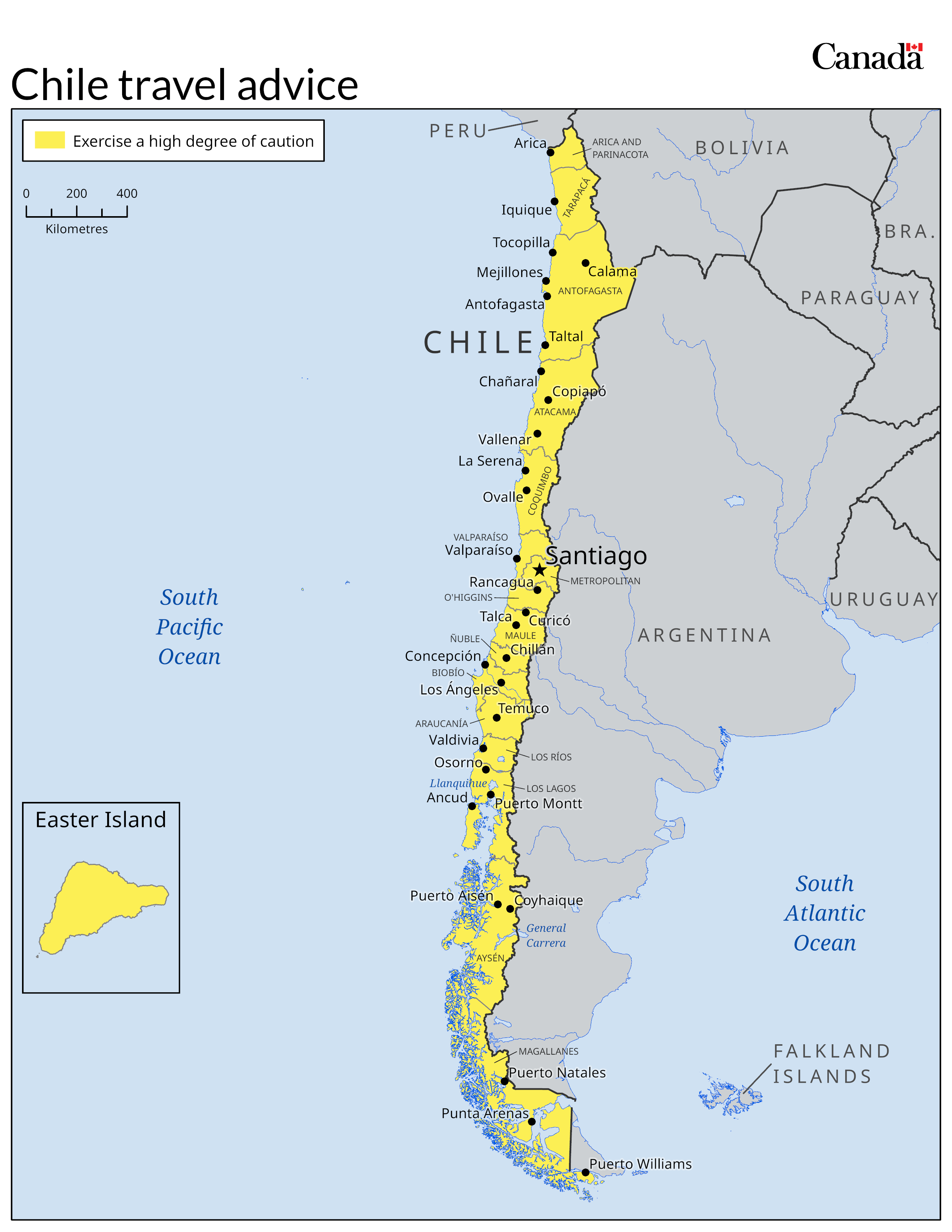
Disclaimer
The features in this map do not constitute an authoritative source of geographical information. This map is solely intended to assist Canadians by illustrating the risk levels contained in the Travel Advice and Advisories for this destination. The features in this map do not necessarily represent the views of the Canadian government on international boundaries, nomenclature or political status. The text under the Risk levels section takes precedence over this map.
Chile travel advice
Disclaimer
The features in this map do not constitute an authoritative source of geographical information. This map is solely intended to assist Canadians by illustrating the risk levels contained in the Travel Advice and Advisories for this destination. The features in this map do not necessarily represent the views of the Canadian government on international boundaries, nomenclature or political status. The text under the Risk levels section takes precedence over this map.
Chile - Exercise a high degree of caution
Exercise a high degree of caution in Chile due to ongoing demonstrations, civil unrest and crime.
 Safety and security
Crime
Petty crime
Petty crime, such as pickpocketing, bag snatching and theft from vehicles, can occur in any part of the country. However, you should remain especially vigilant in larger cities such as:
- Santiago
- Valparaíso / Viña del Mar
- Calama
- Concepción
- Villarica
- Iquique
Theft occurs frequently in:
- popular tourist areas, including lookouts
- bus and train stations and airports
- the subway in Santiago
- shopping malls
- hotel lobbies
- restaurants, including patios located near streets
- gas stations and highway service centres
These types of crimes are often carried out using distraction. Pickpockets and bag snatchers work in pairs or groups and use a variety of ruses to divert their victim’s attention. In some cases, thieves on foot work with thieves on motorcycles, “motochorros,” to snatch purses, cell phones and backpacks.
In Valparaíso and Santiago, thieves target rental cars. They puncture the tire of a vehicle, then steal items when the occupants get out to check the tire.
Another distraction technique involves spilling a substance on victims and then robbing them while pretending to help clean the stain.
During your trip:
- be suspicious of strangers approaching you, because they may attempt to distract and rob you
- do not use your cell phone while walking on the street
- keep bags and purses on your lap instead of on the table or hung on chairs
- keep your personal belongings, including your passport and other travel documents, in a secure place
- keep a copy of your identification or passport with you
- do not carry large sums of cash
- avoid showing signs of affluence or wearing expensive jewellery
On the road:
- do not leave valuables within reach or in plain sight
- keep doors and windows closed and locked at all times
- do not leave personal belongings unattended in a vehicle, even in the trunk
Violent crime
Armed assaults and robberies have increased in recent years. Tourists have been attacked, even during the daytime. Be particularly careful and avoid walking after dark in the following areas:
- around Cerro Alegre and other cerros (hills) in Valparaíso
- in Cerro San Cristóbal park, north of Santiago
- in Santiago:
- in parks
- in the Bellavista and Barrio Lastarria neighbourhoods
- at Cerro Santa Lucia
- in common tourist areas, such as Plaza de Armas and Mercado Central
Carjackings occur, including as drivers leave their vehicles to open or close gates or wait for gates to open or close.
- Always be aware of your surroundings
- If you’re threatened, hand over your cash and valuables without resistance
Residential break-ins are becoming increasingly common, especially in larger cities when properties are unoccupied.
- Keep doors and windows closed and locked at all times
- Keep your personal belongings in a secure place
Express kidnappings
Express kidnappings, where kidnappers demand immediate ransoms, occur occasionally.
Criminals kidnap the victim from the street or a taxi and force the person to withdraw funds from an ATM or transfer funds online. The victim is sometimes held overnight so that a second withdrawal can be made the next day.
These kidnappings occur throughout the country and are often committed by organized gangs, but they can also be committed by taxi drivers.
- Only use reputable taxi companies or ride-sharing applications
- Avoid hailing taxis on the street
- If you're threatened by armed criminals, stay calm and do not resist
- Do not accept rides from new acquaintances or strangers
Araucanía and Biobío regions
There has been politically motivated violence in some parts of the Araucanía and Biobío regions of southern Chile. In 2022, the Government of Chile declared a state of emergency in the area, which is re-evaluated every 30 days.
Violent protests, barricades, looting, arson attacks and fatal shootings have occurred. Exercise caution if you’re travelling in these regions.
Terrorism
There is a threat of terrorism. Explosions of small-scale devices occasionally occur in Santiago.
Targets have included:
- transportation hubs
- churches
- corporate buildings
- businesses
- banks and ATMs
Always be aware of your surroundings when in public places.
Be particularly vigilant during:
- religious holidays
- public celebrations
- major political events, such as elections
Terrorists may use such occasions to mount attacks.
Demonstrations and strikes
Demonstrations and strikes occur frequently in Santiago, including at Plaza Italia, also known as Plaza Baquedano, as well as in Valparaíso and Concepción. They also occur occasionally elsewhere in the country. They may lead to:
- roadblocks
- public transportation disruptions
- confrontations with police, who sometimes use tear gas and/or water cannons
Public sector strikes also occur and can affect service availability.
Large demonstrations often take place on dates of national significance such as:
- March 29 (Day of the Young Combatant)
- May 1 (International Workers’ Day)
- September 11 (anniversary of the 1973 military coup)
- October 18 (anniversary of the 2019 civil unrest)
Even peaceful demonstrations can turn violent at any time. They can lead to disruptions to traffic and public transportation.
- Avoid areas where demonstrations and large gatherings are taking place
- Follow the instructions of local authorities
- Monitor local media for information on ongoing demonstrations
Mass gatherings (large-scale events)
Fraud
Credit and debit card as well as ATM fraud occurs.
When using your debit or credit card:
- cover the keypad with one hand when entering your PIN
- pay careful attention when others are handling your cards
- avoid using card readers with an irregular or unusual feature
- use ATMs located in public areas or inside a bank or business
- check the amount being charged on the card reader
- check for any unauthorized transactions on your account statements
Telephone scams are also frequent in Chile.
- Never provide any personal or financial information over the phone
- Never provide information about the whereabouts of your family members
- Never reply to or click on links in text messages coming from unfamiliar numbers
Women's safety
Women travelling alone may be subject to some forms of harassment or verbal abuse.
Spiked food, drinks and other items
Snacks, beverages, gum and cigarettes may contain drugs that could put you at risk of sexual assault and robbery.
- Be wary of accepting these items from new acquaintances
- Never leave food or drinks unattended or in the care of strangers
- Pay attention when drinks are prepared and served, especially in tourist neighbourhoods such as Santiago’s Bellavista and Suecia neighbourhoods
Adventure travel
Outdoor activities, such as volcano tours, desert expeditions, water activities, hiking, and mountain biking, can be dangerous. Trails are not always marked and weather conditions can change rapidly, regardless of the season.
Safety features in vehicles and on small boats used in river and lake excursions are not always reliable.
If you intend to participate in adventure travel activities:
- share your itinerary with a friend or family member if you’re alone
- use a registered tour/expedition company
- buy travel insurance that covers incidents related to these types of recreational activities and includes helicopter rescue and medical evacuation
- avoid venturing off marked trails
- ensure that you’re adequately equipped and bring sufficient water
- monitor weather conditions and other possible hazards
- know the symptoms of acute altitude sickness, dehydration and heatstroke, which can be fatal
For outdoor activities along the borders with Argentina, Bolivia or Peru, you must register with Chile’s National Department of State Borders and Boundaries (DIFROL).
Useful links
- Adventure travel health and safety
- Parks and wilderness areas – National Forest Corporation (CONAF) (Spanish only)
- Local weather forecast – Chilean Meteorological Service (Spanish only)
- Advice for trekking and mountaineering – Ministry of the Interior and Public Safety (Spanish only)
- Outdoor activities in border areas – DIFROL
Landmines
Marked minefields pose a risk in remote areas bordering the following countries:
- Argentina
- Bolivia
- Peru
If you’re travelling to remote border areas:
- stay on main roads and paved surfaces
- avoid fields, roadside ditches, shoulders and unmarked trails
- cross only at official border crossings
- pay attention to signs indicating the possible presence of landmines
Land border posts with Argentina
Due to weather conditions impacting road safety, authorities regularly close land border posts with Argentina during the winter, from June to September.
- Stay informed of regional weather forecasts
- Plan accordingly
- Follow the instructions of local authorities
Border crossings – Ministry of the Interior (Spanish only)
Roads
Road safety
Road safety may vary considerably across the country.
Accidents, particularly in Santiago, are common.
Road conditions
Road conditions in urban areas are generally very good. However, driving on some secondary roads or in mountainous areas can be dangerous due to:
- insufficient lighting
- lack of guardrails
- poor maintenance
- difficult winter weather conditions
- strong side winds
- unpaved roads
Driving habits
Drivers are often reckless or aggressive, and the road laws are different from those in Canada.
You should drive defensively if you’re driving in Chile.
Public transportation
There has been an increase in recent years of criminal groups targeting tourists using public transportation. They use the ploy of distracting their victims and then taking their belongings on buses and the metro, and at bus stations and airports.
Tourists travelling on intercity buses, especially from Calama to Antofagasta, San Pedro de Atacama or Santiago, have been robbed while sleeping.
- Always be vigilant and take extra care when using public transportation
- Watch your bags at all times while waiting for transportation
- Always carry your valuables and identification with you and avoid storing them in overhead compartments on buses and trains
Taxis
Credit card fraud has happened in unauthorized taxis, particularly at airports. Drivers may pretend to be driving official taxis and charge excessive amounts, sometimes without customers' knowledge. This is done by adding extra digits to the fare or presenting a card reader without a readable display.
When using a taxi from the airport:
- book and prepay for your taxi at an official stand inside the terminal
- beware of people posing as taxi drivers, especially near the terminal exit
- board taxis only in designated areas
- check the amount on the card reader before inserting or tapping your payment card
In cities:
- book a taxi in advance rather than hailing one on the street, especially late in the evening
- never share a taxi with strangers
- avoid using taxis that don’t have a meter
- agree on the fare with the driver before you get in to avoid overcharging
Travelling safely in taxis and buses – Government of Chile (Spanish only)
Travel recommendations
Chile’s national tourism service provides information and safety tips for travellers visiting the country.
Recommendations for travel in Chile – National Tourism Service of Chile
Air travel
We don't make assessments on the compliance of foreign domestic airlines with international safety standards.
 Entry and exit requirements
The authorities of a country or territory decide who can enter or exit through its borders. The Government of Canada cannot intervene on your behalf if you do not meet your destination’s entry or exit requirements.
We have obtained the information on this page from Chilean authorities. It can, however, change at any time.
Verify this information with the Foreign Representatives in Canada.
Chile has strict entry and exit requirements, especially for dual citizens and children.
Passport
Entry requirements vary depending on the type of passport you're travelling with.
Before you travel, check with your transportation company about passport requirements. Its rules on passport validity may be more stringent than the country's entry rules.
Regular Canadian passport
Your passport must be valid for the duration of your stay in Chile.
Passport for official travel
Different entry rules may apply.
Passport with “X” gender identifier
While the Government of Canada issues passports with an “X” gender identifier, it cannot guarantee your entry or transit through other countries. You might face entry restrictions in countries that do not recognize the “X” gender identifier. Before you leave, verify this information with the closest foreign representative for your destination.
You should also be aware that current systems used by some countries and travel companies may not recognize the “X” gender identifier. You may still be asked to provide your sex/gender information as either male or female when travelling.
Other travel documents
Different entry rules may apply when travelling with a temporary passport or an emergency travel document. Before you leave, verify this information with the closest foreign representative for your destination.
Useful links
- Travel and your sexual orientation, gender identity, gender expression and sex characteristics
- Foreign Representatives in Canada
- Canadian passports and other travel documents
Visas
Tourist visa: not required
Business visa: not required
Student visa: required
Work visa: required
Other entry requirements
The Chilean government requires visitors to have at least $46 USD per day available to cover their expenses during their trip. Customs officials may ask you to show them proof of sufficient funds to cover your stay.
Temporary stays – Government of Chile (Spanish only)
Tourist card
You will receive a tourist card upon arrival. The card is valid for a maximum period of 90 days.
You must keep the card and present it to immigration officers upon departure from the country. Failure to do so may result in delays.
Replacing a tourist card
If your card is lost or stolen, you may obtain a new one online.
Alternatively, you may go, well in advance of departure:
- to a special police unit (Jefatura Nacional de Migración y Policia Internacional) in Santiago
- to the nearest office of the Police Investigations Service outside Santiago
Useful links
- Migrations and International Police – Investigations Police of Chile (Spanish only)
- Replacing a tourist card – Police Investigations Service (Spanish only)
Extension of stay
You can request an extension of stay for up to 90 days online. You must do so before your current tourist card’s expiration date. A fee applies.
If you stay in Chile for longer than the allowed period, you will have to pay a fine at the Chilean immigration office before you can leave the country.
Useful links
- Migrations Chile – National Migration Service
- Portal for digital processes – National Migration Service (Spanish only)
Easter Island
Stays on Easter Island (Rapa Nui) are limited to 30 consecutive days for all travellers, including Chileans who reside on the mainland. To board a flight and upon arrival on the island, you will have to show:
- a round-trip ticket
- a passport valid for the duration of the stay
- proof of reservation of an accommodation authorized by local authorities
You’ll also have to complete the Rapa Nui Entry Form.
Useful links
- Travelling requirements – Government of Chile
- Rapa Nui Entry Form – Government of Chile
Dual citizenship
Canadian-Chilean dual citizens residing in Chile must enter and depart the country using their Chilean passport.
Canadian-Chilean dual citizens travelling to Chile on their Canadian passport must request an extension of stay if they decide to stay longer than 90 days. They may have to depart the country on a Chilean passport if they fail to do so.
Children and travel
Chile has strict requirements for the entry and exit of persons under the age of 18, including special documentation. Children travelling with only one parent, with a guardian or alone, are required to carry:
- a notarized, apostilled and translated letter of authorization from the other parent or a court
- the child’s apostilled long-form birth certificate
For more information on these requirements, contact the nearest Chilean embassy or consulate before travelling to Chile. If you’re already in Chile, contact a local Chilean notary public.
Useful links
- Children and travel
- Entry and exit of minors from the country – Minstry of Foreign Affairs (in Spanish only)
- Authentication of documents
Yellow fever
Learn about potential entry requirements related to yellow fever (vaccines section).
 Health
Relevant Travel Health Notices
- Measles: Advice for travellers - 13 November, 2025
- COVID-19 and International Travel - 12 May, 2025
This section has information and advice about health risks you might face when travelling. Following this advice can help reduce your risk of getting sick. Not all risks are listed here.
It's best to talk to a healthcare provider or visit a travel health clinic preferably 6 weeks before your trip to get personalized health advice. Even if your travel date is coming up soon, it's still worthwhile to make an appointment.
Routine vaccines
Make sure your routine vaccinations are up-to-date before you travel, no matter where you’re going.
These may include vaccines for measles, mumps, and rubella (MMR), diphtheria, tetanus, pertussis (whooping cough), polio, varicella (chickenpox), meningococcal disease, seasonal flu, and others.
Provincial and Territorial Immunization Information
Pre-travel vaccines and medications
When travelling in this destination, you might be at risk for diseases that can be prevented with vaccines or medications. Talk to a travel health care provider about which ones are right for you based on your travel plans.
The highlights below will also tell you if your destination may require that vaccine for entering or exiting.
Yellow Fever - Country Entry Requirements
Yellow fever is a disease caused by a flavivirus from the bite of an infected mosquito.
Travellers get vaccinated either because it is required to enter a country or because it is recommended for their protection.
Risk
- There is no risk of yellow fever in this country.
Country Entry Requirement*
- Proof of vaccination is not required to enter this country.
Recommendation
- Vaccination is not recommended.
* It is important to note that country entry requirements may not reflect your risk of yellow fever at your destination. It is recommended that you contact the nearest diplomatic or consular office of the destination(s) you will be visiting to verify any additional entry requirements.
Hepatitis A
There is a risk of hepatitis A in this destination. It is a disease of the liver. People can get hepatitis A if they ingest contaminated food or water, eat foods prepared by an infectious person, or if they have close physical contact (such as oral-anal sex) with an infectious person, although casual contact among people does not spread the virus.
Practise safe food and water precautions and wash your hands often. Vaccination is recommended for all travellers to areas where hepatitis A is present.
Influenza
The best way to protect yourself from seasonal influenza (flu) is to get vaccinated every year. Get the flu shot at least 2 weeks before travelling.
The flu occurs worldwide.
- In the Northern Hemisphere, the flu season usually runs from November to April.
- In the Southern Hemisphere, the flu season usually runs between April and October.
- In the tropics, there is flu activity year round.
The flu vaccine available in one hemisphere may only offer partial protection against the flu in the other hemisphere.
The flu virus spreads from person to person when they cough or sneeze or by touching objects and surfaces that have been contaminated with the virus. Clean your hands often and wear a mask if you have a fever or respiratory symptoms.
Rabies
In this destination, rabies may be present in some wildlife species, including bats. Rabies is a deadly disease that spreads to humans primarily through bites or scratches from an infected animal.
If you are bitten or scratched by an animal while travelling, immediately wash the wound with soap and clean water and see a health care professional.
Before travel, discuss rabies vaccination with a health care professional. It may be recommended for travellers who will be working directly with wildlife.
Measles
Measles is a serious viral infection that spreads easily. It spreads through the air, and can stay in the air for up to 2 hours. You can also get measles by direct contact with an infected person or by touching a surface with the virus on it and then touching your eyes, nose, or mouth before washing your hands.
Getting vaccinated is the best way to protect yourself and others from measles. In Canada, the measles vaccine is part of the routine immunization schedule. If you’re unsure whether you’re protected, talk to a healthcare provider.
Learn more:
Hepatitis B
Hepatitis B is a risk in every destination. It is a viral liver disease that is easily transmitted from one person to another through exposure to blood and body fluids containing the hepatitis B virus. Travellers who may be exposed to blood or other bodily fluids (e.g., through sexual contact, medical treatment, sharing needles, tattooing, acupuncture or occupational exposure) are at higher risk of getting hepatitis B.
Hepatitis B vaccination is recommended for all travellers. Prevent hepatitis B infection by practicing safe sex, only using new and sterile drug equipment, and only getting tattoos and piercings in settings that follow public health regulations and standards.
COVID-19
COVID-19 is an infectious viral disease. Most of the time, it spreads when people are in close contact with others who are infected with the virus. It spreads through respiratory particles, or through an infected surface or object.
Vaccination is one of the most important ways to protect yourself from developing serious complications from COVID-19. Talk to a healthcare provider about the COVID-19 vaccine before travelling. Evidence shows that the COVID-19 vaccines used in Canada are very effective at preventing severe illness, hospitalization and death from COVID-19.
In addition to vaccination, use personal protective measures to help protect yourself and others.
Learn more :
Vaccine for COVID-19: How to get vaccinated
COVID-19: Spread, prevention and risks
Safe food and water precautions
Eating or drinking unsafe food or water, or swimming in contaminated water can make you sick while travelling. Take precautions by following these tips:
- Boil it, cook it, peel it, or leave it (only eat food that is prepared safely)
- Avoid, if possible, getting water in your eyes, mouth, or nose when swimming in freshwater (like streams, lakes, or canals), especially after heavy rain or flooding - the water might look clean but can still be contaminated
- Don’t swallow water when bathing, showering, swimming in pools, or using hot tubs
Typhoid
Typhoid is a bacterial infection spread by contaminated food or water. Risk is higher among children, travellers going to rural areas, travellers visiting friends and relatives or those travelling for a long period of time.
Travellers visiting regions with a risk of typhoid, especially those exposed to places with poor sanitation, should speak to a health care professional about vaccination.
Tick and insect bite prevention
Many diseases are spread by bites from infected ticks and insects like mosquitoes, fleas, or flies. Before you travel, find out what types of ticks or insects are in the area, when they’re most active, and what diseases they can spread.
To protect yourself from bites:
- use an approved bug spray (insect repellent) on exposed skin
- wear light-coloured, loose clothing made of tightly woven materials like nylon or polyester
- wear socks and closed-toe shoes
- sleep under mosquito netting if you’re outdoors or staying in places that aren’t fully enclosed
- do a full body tick check on yourself, your children, your gear, and any pets you’re travelling with when you return from outdoor activities
Insect bite and pest prevention
Personal insect repellents
Chikungunya
There is a risk of chikungunya in this country. The level of risk may vary by:
- season
- year
- region
- elevation
The virus that causes chikungunya is spread through the bite of an infected mosquito. It can cause fever and pain in the joints. In some cases, the joint pain can be severe and last for months or years.
Protect yourself from mosquito bites at all times.
Insect bite and pest prevention
A vaccine for the prevention of chikungunya is approved in Canada. Talk to your healthcare provider about how best to prevent chikungunya, including the benefits and risks of vaccination based on factors such as your age, itinerary and personal preferences.
Learn more:
American trypanosomiasis
American trypanosomiasis (Chagas disease) is a risk in this country. It is caused by a parasite spread by infected triatomine bugs. The infection can be inactive for decades, but humans can eventually develop complications causing disability and even death.
Risk is generally low for most travellers. Protect yourself from triatomine bugs, which are active at night, by using mosquito nets if staying in poorly-constructed housing. There is no vaccine available for Chagas disease.
Dengue
- In this country, dengue is a risk to travellers. It is a viral disease spread to humans by mosquito bites.
- Dengue can cause flu-like symptoms. In some cases, it can lead to severe dengue, which can be fatal.
- The level of risk of dengue changes seasonally, and varies from year to year. The level of risk also varies between regions in a country and can depend on the elevation in the region.
- Mosquitoes carrying dengue typically bite during the daytime, particularly around sunrise and sunset.
- Protect yourself from mosquito bites. There is no vaccine or medication available in Canada to prevent dengue.
Learn more:
Dengue
Insect bite and pest prevention
Animal precautions
Some infections can spread directly from animals to people, like rabies or bird flu (avian influenza). Others don’t spread directly from animals but can infect people who visit areas animals have contaminated with their droppings or body fluids.
Certain activities can increase your chances of coming into contact with animals, their droppings, or their body fluids, like:
- travelling in rural or forested areas
- camping, hiking, or visiting caves
- visiting places where live animals are sold or killed for food, like wet markets
To reduce your risk of getting sick:
- avoid contact with animals like stray dogs, livestock (such as pigs and cows), monkeys, snakes, rodents, birds, and bats.
- stay away from places where animal waste can build up, such as caves
- avoid eating undercooked meat
Make sure to closely watch children; they are more likely to try to touch animals.
Avian Influenza
Human cases of avian influenza have been reported in this destination. Avian influenza is a viral infection that can spread quickly and easily among birds and in rare cases it can infect mammals, including people. The risk is low for most travellers.
Avoid contact with birds, including wild, farm, and backyard birds (alive or dead) and surfaces that may have bird droppings on them. Ensure all poultry dishes, including eggs and wild game, are properly cooked.
Travellers with a higher risk of exposure include those:
- visiting live bird/animal markets or poultry farms
- working with poultry (such as chickens, turkeys, domestic ducks)
- hunting, de-feathering, field dressing and butchering wild birds and wild mammals
- working with wild birds for activities such as research, conservation, or rehabilitation
- working with wild mammals, especially those that eat wild birds (e.g., foxes)
All eligible people are encouraged to get the seasonal influenza shot, which will protect them against human influenza viruses. While the seasonal influenza shot does not prevent infection with avian influenza, it can reduce the chance of getting sick with human and avian influenza viruses at the same time.
Person-to-person infections
When travelling, you can reduce your risk of getting or spreading respiratory infections, like the flu or COVID-19, by:
- staying at your accommodation and limiting contact with others if you’re sick
- wearing a well-fitting mask, especially:
- if you’re sick and need to be around others
- when you’re at large indoor events or in crowded settings, like sporting events, concerts, and airports
- cleaning your hands regularly with soap and water for at least 20 seconds, or using hand sanitizer containing at least 60% alcohol
- covering your coughs and sneezes with a tissue or your elbow, not your hands
Mass gatherings (large-scale events)
Clean your hands to help reduce the spread of infectious diseases
Respiratory infectious diseases: How to reduce the spread with personal protective measures
To lower your risk of getting sexually transmissible infections (STIs), HIV, and mpox, you can:
- get vaccinated against mpox if you’re eligible
- practise safer sex methods
- use barrier protection during sexual activity, like condoms and dental dams.
Mpox vaccines
Sexual health and travel
HIV and AIDS: Travel health advice
Medical services and facilities
Health care in Chile is good, especially at private facilities. Service is widely available in Santiago and other major cities but can be very limited in remote areas.
Treatment at private clinics and hospitals is expensive. Most doctors and smaller hospitals typically require advance payment.
If you have a pre-existing health condition, carry an up-to-date medical report from a Canadian physician for reference.
Make sure you get travel insurance that includes coverage for medical evacuation and hospital stays.
Health and safety outside Canada
Keep in Mind...
The decision to travel is the sole responsibility of the traveller. The traveller is also responsible for his or her own personal safety.
Be prepared. Do not expect medical services to be the same as in Canada. Pack a travel health kit, especially if you will be travelling away from major city centres.
 Laws and culture
You must abide by local laws.
Learn about what you should do and how we can help if you are arrested or detained abroad.
Drugs
Penalties for possession, use or trafficking of illegal drugs are severe. Convicted offenders can expect jail sentences and heavy fines.
- Pack your own luggage and monitor it closely at all times
- Never transport other people’s packages, bags or suitcases
National parks
Protected areas of national parks are safeguarded by Chilean legislation. Penalties for violations can be severe, especially in the case of fires.
Open fires are strictly forbidden in national parks outside permitted camping areas. This includes burners for cooking purposes.
Local authorities may revoke your tourist card if you’re caught starting a fire illegally. They may ask you to depart Chile within 72 hours or you may be subjected to deportation proceedings. You may also face detention and heavy fines if the open fire results in a forest fire.
- Respect protected areas, even if there are no warnings or signs to this effect
- Ensure you have a good understanding of local rules and regulations before entering national parks
National Forest Corporation (CONAF) (Spanish only)
Heritage sites
Heritage areas are safeguarded by Chilean legislation. Penalties for violations can be severe, from payment of a fine to imprisonment. If you are detained for breaching the rules of a heritage site, local authorities may prevent you from leaving the country during the investigation.
- Ensure you have a good understanding of local site rules and regulations
- Don’t alter landmarks in any way
Importation of agricultural products
Chile imposes severe restrictions on the importation of agricultural products, such as food and animal products.
Make sure to declare all agriculture items on your customs form when entering Chile, including packaged products, or you may face detention and heavy fines. You can also complete a Digital Affidavit for Entry to Chile before arrival.
Useful links
- Chilean customs regulations – National Customs Service (Spanish only)
- Digital Affidavit for Entry to Chile – Agriculture and Livestock Service (Spanish only)
Driving
You can drive with your valid Canadian driver’s licence for up to 90 days. However, you should still carry an international driving permit. If you’re a resident of Chile, you must apply for a Chilean driver’s licence from the municipality in which you live.
The country has a zero-tolerance policy for drinking and driving. Penalties include:
- licence suspension
- fines
- detention
Right turns at red lights are prohibited, unless otherwise posted.
Some car rental companies may not allow for international trips. If you intend to travel outside the country in a rental vehicle:
- make sure the rental company allows it before making your reservation
- request written authorization from the car rental company 3 to 5 days before your trip
Insurance
Some insurance companies might not cover pickup truck rentals or have exclusions related to damage caused on unpaved roads.
There is no car insurance available on Easter Island. In case of accident or damage to your rented vehicle, you will have to pay for the repairs yourself.
Restrictions in Santiago
To combat high levels of pollution in the winter, restrictions on driving in central Santiago, within the Américo Vespucio ring road, are in place from May to September.
Vehicles with a green seal registered before September 1, 2011, are subject to a daily restriction based on the last two digits of the licence plate. When there is an alert, restrictions are in effect from Monday to Friday between 7:30 am and 9 pm.
If a pre-emergency or environmental emergency is decreed, additional digits could be restricted.
You can check the list of affected plate numbers in newspapers and online.
Vehicle restrictions – Ministry of Transport and Telecommunications (Spanish only)
Political activities
Chilean law prohibits political activities by foreigners. Participating in demonstrations or promoting dissent, including on social media, may result in you being detained and/or deported.
2SLGBTQI+ persons
Chilean law does not prohibit sexual acts between individuals of the same sex.
While homosexuality is generally tolerated, Chilean society remains fairly conservative. 2SLGBTQI+ persons could be discriminated against based on their sexual orientation, gender identity, gender expression or sex characteristics.
Travel and your sexual orientation, gender identity, gender expression and sex characteristics
Dual citizenship
Dual citizenship is legally recognized in Chile.
If you are a Canadian citizen, but also a citizen of Chile, our ability to offer you consular services may be limited while you're there. You may also be subject to different entry/exit requirements.
International Child Abduction
The Hague Convention on the Civil Aspects of International Child Abduction is an international treaty. It can help parents with the return of children who have been removed to or retained in certain countries in violation of custody rights. The convention applies between Canada and Chile.
If your child was wrongfully taken to, or is being held in Chile, and if the applicable conditions are met, you may apply for the return of your child to the Chilean court.
If you are in this situation:
- act as quickly as you can
- contact the Central Authority for your province or territory of residence for information on starting an application under The Hague Convention
- consult a lawyer in Canada and in Chile to explore all the legal options for the return of your child
- report the situation to the nearest Canadian government office abroad or to the Vulnerable Children's Consular Unit at Global Affairs Canada by calling the Emergency Watch and Response Centre
If your child was removed from a country other than Canada, consult a lawyer to determine if The Hague Convention applies.
Be aware that Canadian consular officials cannot interfere in private legal matters or in another country's judicial affairs.
Useful links
- List of Canadian Central Authorities for the Hague Convention
- International Child Abductions: A guide for affected parents
- Children and travel
- The Hague Convention – Hague Conference on Private International Law
- Canadian embassies and consulates by destination
- Request emergency assistance
Money
The currency of Chile is the Chilean peso (CLP).
Some small restaurants and stores outside Santiago may not accept credit cards.
U.S. dollars are easily exchanged at banks and official foreign exchange bureaus across the country. However, purchases in U.S. dollars can only be made in certain stores in Santiago.
 Natural disasters and climate
Chile is subject to various natural disasters such as:
- volcanic eruptions
- earthquakes and tsunamis
- torrential rains, floods and mudslides
- wildfires
- coastal swells
- tornadoes
Border crossings can close due to severe weather conditions.
Useful links
- Latest alerts – National Service for Prevention and Response to Natural Disasters (SENAPRED) (Spanish only)
- Border crossings – Ministry of the Interior (Spanish only)
Volcanoes
There are 500 active volcanoes in Chile. Local authorities closely monitor the following volcanoes:
- Villarica
- Osorno
- Llaima
- Calbuco
- Grupo Descabezados
Debris from erupting volcanoes can clog rivers and cause them to overflow, resulting in flash floods and landslides. Ash clouds may also cause disruptions to domestic and international flights.
If you’re travelling near active volcanoes:
- monitor levels of volcanic activity through the local media
- pay careful attention to all warnings issued
- follow the instructions of local authorities
- be prepared to modify your travel arrangements or even evacuate the area on short notice
Useful links
- Volcano alerts – National Geology and Mining Service (Spanish only)
- Volcanic eruptions – National Service for Disaster Prevention and Response (SENAPRED)
Earthquakes and tsunamis
Chile is located in a very active seismic zone. Earthquakes and tsunamis can occur anywhere throughout the country.
A tsunami can occur within minutes of a nearby earthquake. However, the risk of a tsunami can remain for several hours following the first tremor. If you're staying on the coast, familiarize yourself with the region's evacuation plans in the event of a tsunami warning.
In the event of an earthquake or tsunami:
- monitor local media for the latest information
- follow the instructions of local authorities, including evacuation orders
Useful links
- Earthquakes – National Service for Disaster Prevention and Response (SENAPRED)
- Latest alerts – National Service for Disaster Prevention and Response (SENAPRED) (Spanish only)
- Latest earthquakes – U.S. Geological Survey
- Tsunami alerts – U.S. Tsunami Warning System
Torrential rains, flooding and mudslides
Flooding is frequent during the fall and the winter, especially between May and August. It occurs throughout the country, mainly as a result of heavy rains and overloaded sewage systems. Seasonal flooding can hamper overland travel and reduce the provision of essential services. Roads may become impassable and bridges damaged.
Flooding from rising river levels after heavy rain can cause injuries and deaths.
Avoid riverside accommodations, especially in central and southern Chile, because dry riverbeds swell rapidly.
Useful links
- Winter – National Service for Disaster Prevention and Response (SENAPRED)
- Floods – National Service for Disaster Prevention and Response (SENAPRED)
- Mudflows – National Service for Disaster Prevention and Response (SENAPRED)
Coastal swells
Dangerous waves caused by large ocean swells occur along the Chilean coast. Large waves carrying rocks and other debris can occur without warning and even when the weather is clear.
If you plan to travel near the coast:
- monitor local swell reports
- exercise caution in coastal and rocky areas
- do not enter the ocean or engage in water activities when swell warnings are in force
Useful links
- Marine forecasts – Chilean Navy Weather Service (some information in Spanish only)
- Sea surges – National Service for Disaster Prevention and Response (SENAPRED)
Wildfires
Bush and forest fires are common during the summer months, from December to March. They can happen anywhere, but they usually occur between Santiago and Valparaíso, and in Magallanes.
Heavy smoke may deteriorate the air quality in areas near active fires.
In case of a major fire:
- stay away from affected areas, particularly if you suffer from respiratory ailments
- monitor local media for the latest information
- follow the instructions of local authorities, including evacuation orders
Useful links
- Current situation and fire forecast – National Forest Corporation (CONAF) (Spanish only)
- Latest alerts – National Service for Disaster Prevention and Response (SENAPRED) (Spanish only)
- Wildfires – National Service for Disaster Prevention and Response (SENAPRED)
Air pollution
Santiago is one of the most polluted cities in South America. Heavy smog can pose serious health hazards from May to October.
The ozone layer is especially thin over parts of Chile.
Take precautions to protect yourself from sunburn and avoid going outdoors when the pollution levels are high.
Useful links
- Regional UV index – University of Santiago (Spanish only)
- National Air Quality Information System – Ministry of the Environment (Spanish only)
 Need help?
Local services
Emergency services
In case of emergency, dial:
- police: 133
- medical assistance: 131
- firefighters: 132
- helpline for women victims of violence: 1455
- maritime search and rescue: 137
Consular assistance
Santiago - Embassy of Canada
For emergency consular assistance, call the Embassy of Canada to Chile, in Santiago, and follow the instructions. At any time, you may also contact the Emergency Watch and Response Centre in Ottawa.

Disclaimer
The decision to travel is your choice and you are responsible for your personal safety abroad. We take the safety and security of Canadians abroad very seriously and provide credible and timely information in our Travel Advice to enable you to make well-informed decisions regarding your travel abroad.
The content on this page is provided for information only. While we make every effort to give you correct information, it is provided on an "as is" basis without warranty of any kind, expressed or implied. The Government of Canada does not assume responsibility and will not be liable for any damages in connection to the information provided.
If you need consular assistance while abroad, we will make every effort to help you. However, there may be constraints that will limit the ability of the Government of Canada to provide services.
Learn more about consular services.
Risk Levels
 Take normal security precautions
Take similar precautions to those you would take in Canada.
 Exercise a high degree of caution
There are certain safety and security concerns or the situation could change quickly. Be very cautious at all times, monitor local media and follow the instructions of local authorities.
IMPORTANT:The two levels below are official Government of Canada Travel Advisories and are issued when the safety and security of Canadians travelling or living in the country or region may be at risk.
 Avoid non-essential travel
Your safety and security could be at risk. You should think about your need to travel to this country, territory or region based on family or business requirements, knowledge of or familiarity with the region, and other factors. If you are already there, think about whether you really need to be there. If you do not need to be there, you should think about leaving.
 Avoid all travel
You should not travel to this country, territory or region. Your personal safety and security are at great risk. If you are already there, you should think about leaving if it is safe to do so.
- Date modified: