
Mpox: Advice for travellers

Level 2 - Practise enhanced health precautions (more details)
Original publication date: June 7, 2022
Updated: September 29, 2025
Key points
- There are ongoing outbreaks of clade I mpox in the Democratic Republic of Congo and surrounding countries in Africa.
- Mpox is a viral infection with a rash that may be painful. Most people recover without treatment after a few weeks.
- Travellers can lower their risk of getting mpox by avoiding close physical contact with someone who has mpox, by practising safer sex methods, and by following other recommendations below.
- The mpox vaccine is not routinely recommended for travellers, however, if you meet certain high-risk criteria, you may be eligible.
Current situation
- There are two main subtypes of the mpox virus, called clades: clade I and clade II.
- Current information suggests that infection with clade I mpox virus may be more likely to cause severe illness and death compared to clade II.
- Mpox can be spread from person to person, causing outbreaks. Outbreaks of this type are occurring in the following countries:
- Burundi
- Democratic Republic of Congo (DRC)
- Ethiopia
- Kenya
- Malawi
- Mozambique
- Republic of Congo
- Rwanda
- Tanzania
- Uganda
- Zambia
- There have also been travel-related clade I mpox cases reported outside of the African region.
Recommendations
Before you leave
- Talk to a health care provider or visit a travel health clinic preferably about 6 weeks before your departure date, to get personalized health advice. Even if your travel date is coming up soon, it's still worthwhile to make an appointment.
- Delay your travel if you have any symptoms of mpox, or have been diagnosed with mpox.
- Sign up with the Registration of Canadians Abroad service to stay connected with the Government of Canada in case of an emergency abroad or an emergency at home.
Registration of Canadians Abroad
Vaccination for travellers
- The mpox vaccine is not routinely recommended for travellers without known exposure to mpox, unless they:
- meet high-risk criteria
- are a health care professional being deployed to support mpox clade I outbreaks (see information for health professionals section)
- Before travel, check with your local public health authority to see if you are eligible for the mpox vaccine. The vaccine requires at least 4 weeks between the two doses.
Vaccines for mpox high-risk criteria
While you’re away
You can be exposed to mpox in different situations, such as during:
- sexual contact
- including oral or non-penetrative contact
- close contact, including when:
- providing care at home
- living in the same household
Mpox is most often spread between people through:
- contact with lesions or scabs of a person with mpox
- contact with bodily fluids of a person with mpox
To lower your risk of getting mpox:
- avoid close physical contact, including sexual contact, with someone who has mpox
- avoid close physical contact, including sexual contact, with someone who may have had a high-risk exposure to mpox, such as a sexual partner or household member of someone with mpox.
- avoid contact with all personal items and objects used by someone with mpox
You can also lower your risk by:
- getting vaccinated against mpox, if you’re eligible
- using barrier protection during sexual activity, including:
- condoms
- dental dams
- gloves
- clothing
- cleaning your hands regularly with soap and water for at least 20 seconds or using a hand sanitizer containing at least 60% alcohol for 20 seconds or until dry
Learn more:
Sexual health and travel
Preventing the spread of mpox
Clean your hands to help reduce the spread of infectious diseases
Monitor your health
- Be aware of the symptoms of mpox and talk and to a health care provider if you notice any new rash or lesions, even with no other symptoms.
- If you’ve been exposed to mpox, watch for symptoms for 21 days, and avoid taking medications that are known to lower fever, such as acetaminophen, ibuprofen and acetylsalicylic acid. They may mask an early symptom of mpox infection.
- If you develop mpox symptoms when you are travelling or after your return, you should immediately:
- isolate away from others
- contact a health care provider or local public health authority for advice on what to do
- If you have symptoms that could be due to mpox during the flight, tell the flight attendant before you land or the border services officer as you enter the country. They will notify a quarantine officer who can assess your symptoms.
Learn more:
Mpox: If you have mpox
Mpox: If you've been exposed
Mpox: Symptoms, testing, care and treatment
If you become sick or injured while travelling outside Canada or after your return
About mpox
- Mpox is a viral infection with a rash that may be painful. Most people recover without treatment after a few weeks. In rare cases, people can become very sick and die.
- Symptoms usually start 7 to 10 days after being exposed to the virus, but they can appear as early as 3 or as late as 21 days.
- The rash can be painful and can show up anywhere on the body, including
- face and mouth
- arms and legs
- hands and feet
- anus, rectum and genitals
- Other symptoms may include:
- fever
- chills
- headache
- exhaustion
- swollen lymph node
- back, joint and muscle pain
- People are contagious from the time symptoms start until the scabs have fallen off and the skin is healed.
Learn more:
Mpox: How it spreads, prevention and risks
Mpox: Symptoms, testing, care and treatment
Information for health professionals
- Mpox (monkeypox): For health professionals
- National Advisory Committee on Immunization (NACI): Interim guidance on the use of Imvamune in the context of a routine immunization program
- Summary of NACI statement of May 15, 2025: Rapid response concerning updated guidance on the use of Imvamune for the prevention of mpox
- World Health Organization: Monkeypox fact sheet
- European Centre for Disease Control and Prevention: Factsheet for health professionals on mpox (monkeypox)
- Public Health England: Monkeypox: information for primary care
- Centers for Disease Control and Prevention: Mpox
- World Health Organization: Monkeypox outbreak
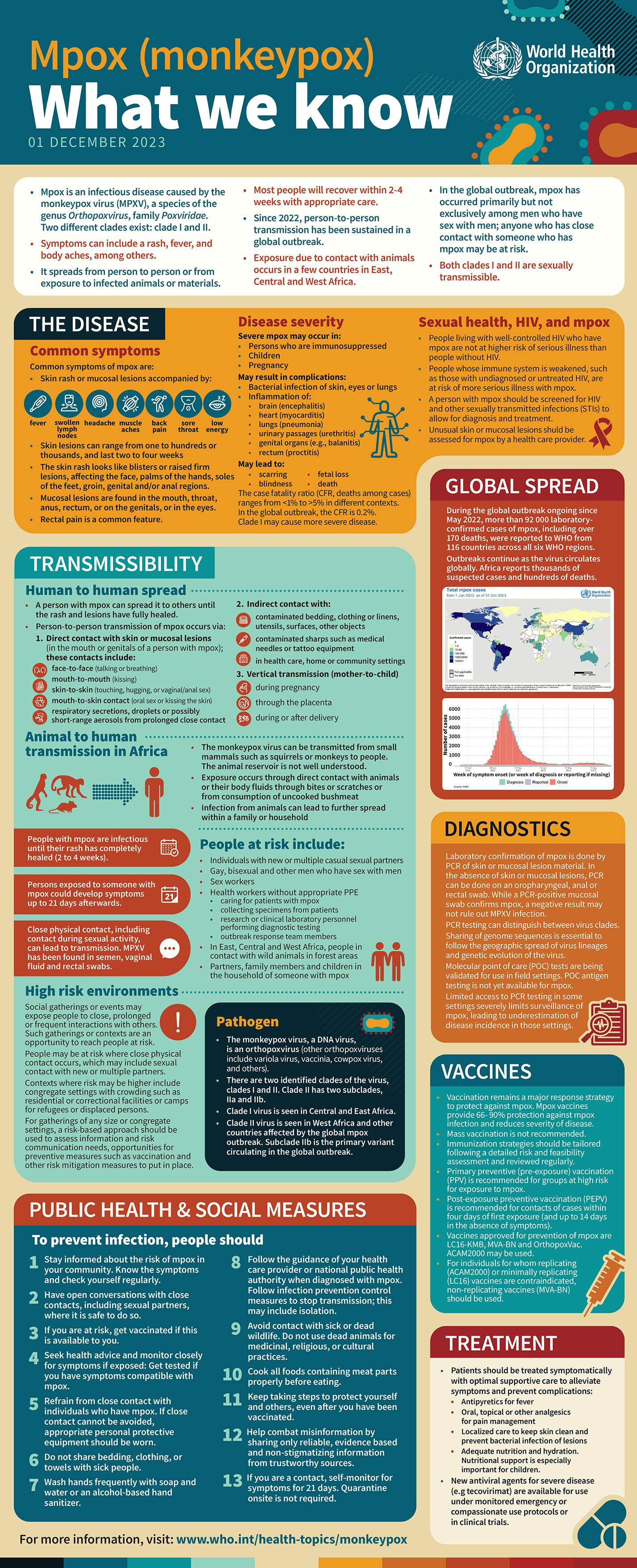
- World Health Organization: Infographic - Mpox: What we know
- Date modified: